Showing posts with label Vietnam. Show all posts

Wednesday, December 5, 2012

Cost: A Luxurious Experience in Vietnam on a Backpacker Budget

We know that everyone spends differently, and a budget can be extremely variable; however, after leaving an area, we want to provide some perspective on the cost associated with staying there for anyone interested in doing a similar trip.  Our budget of $150/day (our initial lower target range was $100 but we are obviously nowhere close to that!) is for 2 people and does not include the $10,000 round-the-world flights (plus trip insurance) already paid for.  The budget also does not account for the bills we are continuing to pay at home.  The bulk of our budget allows for low-to-mid-range lodging in hostels, budget hotels, or guesthouses for a target of $60/double; meals/drinks; use of public transportation; and cost to do some sightseeing and/or activities.  At $150/day, we have found we are not depriving ourselves from any experiences; except that, as foodies, we aren't as liberal with our budget on finding the best and trendiest restaurants (which we haven't missed at all).  An article titled, "Set Your Daily Number" by the veteran travel bloggers from Married With Luggage confirms that a daily average is a simple strategy for setting and meeting a budget.  We've got in the habit of taking a few minutes to record our daily expenditure so we can make small adjustments along the way.

29-DAYS IN VIETNAM
Total $4190 or $145/day!  We just finished traveling through our 3rd Southeast Asian country, Vietnam.  Normally, we would've expected the cost to be similar to Thailand and Cambodia where we spent ~$130/day, but we weren't sure after we splurged on a few travel details on our final leg of our round-the-world trip.

Incredibly, after a 3-day luxury cruise in Halong Bay, several overnight train rides, coughing up airfare to get back down to Ho Chi Minh City (HCMC) in 2 hours instead of 3 days, and staying in mostly real hotels, we have managed to make it (barely) under our $150/day budget in Vietnam!  

Here's our cost breakdown.

Monday, December 3, 2012

Cruising the Bai Tu Long Bay (Northeast of Halong Bay) with IndochinaJunk, Inc.


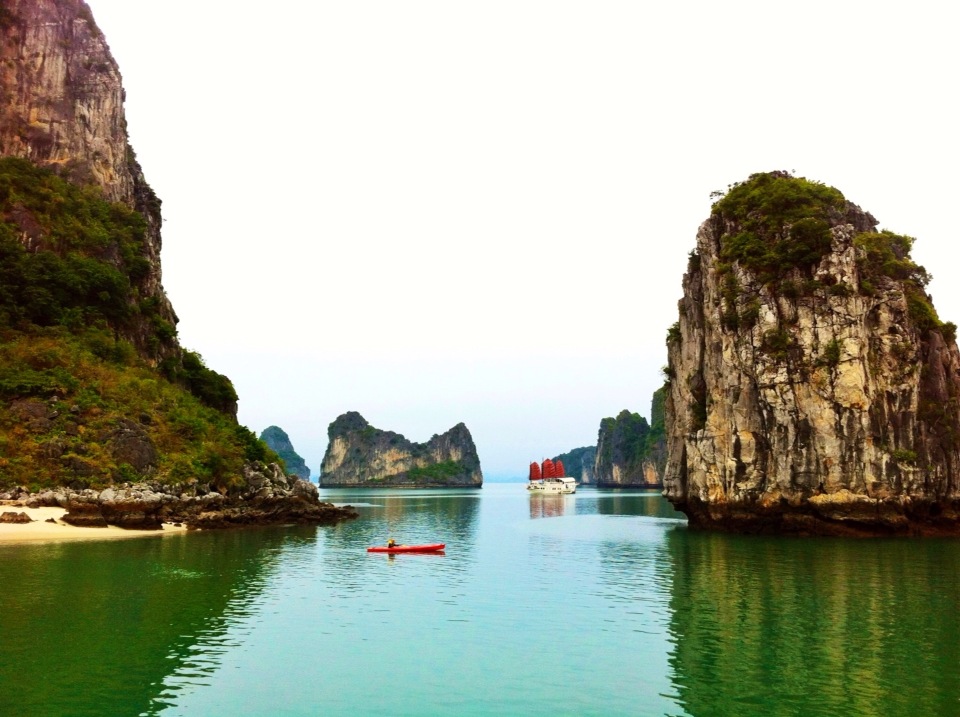
Halong Bay. Ha Long means "descending dragon".  Local legend says that a family of dragons descended onto the bay to protect Vietnam from invaders by spitting large jade and jewels into the water, forming thousands of island barriers against the invaders.  Afterwards, the dragons decided to stay and make these waters their home.  We think you will quickly see that the islands are reminiscent of dragons resting in the water.  

Apparently, we saved the best experience for last! We think this UNESCO World Heritage site and 7 New Wonders of Nature is one of the most stunning natural landscapes we've seen so far on our trip. Right up there with Plitvice Lakes in Croatia.  Yes, Machu Picchu (Peru), Angkor Wat (Cambodia), and the rice terraces of Sapa (Vietnam) were also awe-inspiring, but they are largely man-made wonders.  The two thousand limestone formations that pepper the northernmost bay of Vietnam was formed naturally over millions of years through erosion.  Even more amazing are all the hidden caves and lakes inside these hollow islands, where many have yet to be discovered.  

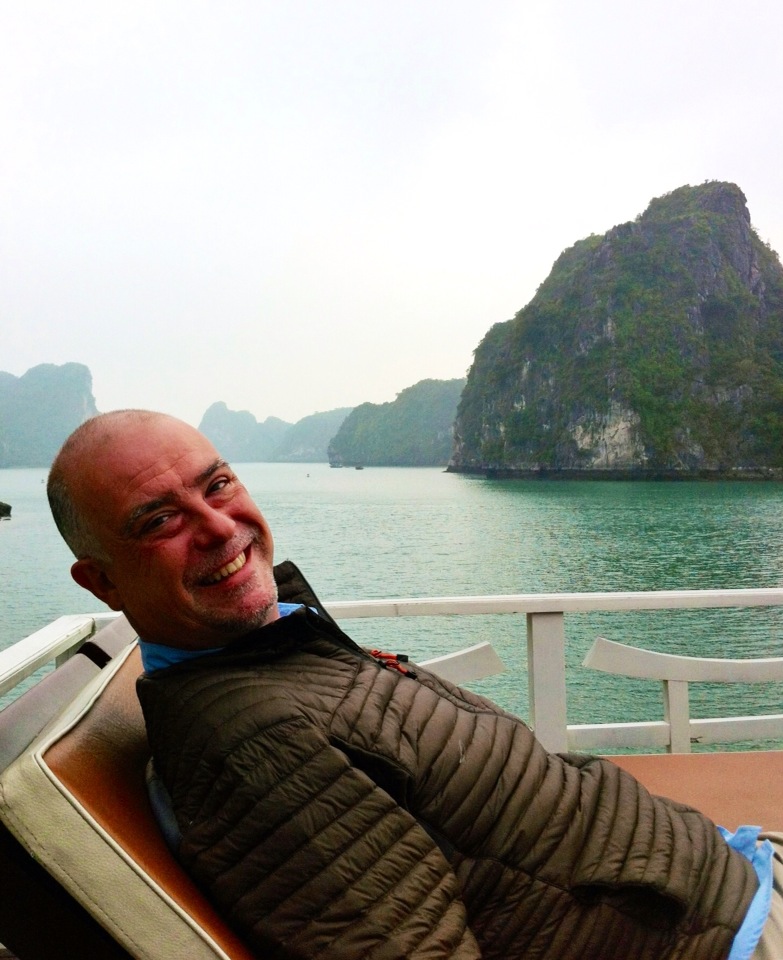
Mike relaxing on the top deck
of Dragon's Pearl I junk cruise.
As a result, Halong Bay was definitely on our "must-see" list, but we didn't know how to best experience this place.  Do we just find transportation to Halong Bay on our own, then find a day boat to take us around?  Do we sign-up for a one or two night cruise?  Should we just go to Cat Ba island, the backpacker capital, and admire the limestone formations from the shore?

Although we prefer DIY travels, this is one place that is best experienced by joining a tour.  Unfortunately, it seems every hotel and business in Hanoi has a cousin or brother-in-law that supposedly runs a tour.  There are soooooo many tour operators to Halong Bay that it is hard to know what's legitimate and what's not.  After much research, we decided on a 3-day/2-night cruise through the less touristed Bai Tu Long Bay just northeast of Halong Bay for a full and unhurried experience.  

We wrote an unsolicited infomercial on how we researched and selected Indochina Junk as well as other options at the end of this blog.*

Thursday, November 29, 2012

Go Take A Hike...With Us in Sapa!


I'm not ashamed to admit that I had to get some (okay...A LOT of) hands-on assistance from a 12-year old (who probably weighed 70 lbs. soaking wet) and a lady in plastic sandals with a baby strapped to her back, in order to prevent myself from sliding down the cliff during our muddy and slippery trek through the rice terraces of Sapa and the Lao Chai and Ta Van Hmong villages.  Welcome to "real trekking" in Sapa, Vietnam.


Fog dissipating, revealing the beautiful rice terraces and river valley below. We were about to start trekking down into the valley.
It's pure dumb luck that on the second day, the sun came out and the fog decided to dissipate.  Especially since we talked to several people who were leaving without having had a single fog-free day in Sapa.  We took full advantage by going on a day hike. 


We woke up to this promising view on our second day in Sapa!  Beautiful blue skies above the cloud line
There's many trekking options.  A few popular ones take hikers and cyclists to Heaven's Gate or Ham Rong Mountain, or the real adventurous may attempt to climb the summit of Fansipan.  On a clear day, we hear the view from atop the mountains and the highest mountain pass (Heaven's Gate) is well...heavenly, but we wouldn't have been able to see much of the valley.  We decided on a guided hike that took us below the cloud lines into the villages instead of going higher.  

Sapa: A Mountain Town Covered in Thick Fog


In front of Tien Sa waterfall
near Cat Cat Village.
We finally made it into the northwestern mountains of Vietnam near the China border to an area called Sapa, famous for the patterned rice terraces carved out of the side of the mountains.  Once you've seen the view, it's easily recognizable as belonging to Sapa.  

As if the rice terrace landscape wasn't good enough, they are surrounded by sheer granite walls rising from crystal clear river canyons, bamboo forests soaring into the heavens, peppered with villages of Hmong tribes dressed in their colorful attire.  Sapa couldn't be more picture perfect.

Picture perfect, unless surrounded by dense fog with a visibility of about 20 feet...which was our Sapa experience on our first day here.

Here's what we should've been able to see in Sapa: 

Postcards of scenic Sapa area. 
Here's what we actually saw:


The fog gave the landscape a unique, mysterious shroud that was equally beautiful, but we wished we'd seen the dramatic views today.

Sunday, November 25, 2012

The Vibrant Sunday Market at Bac Ha, Vietnam

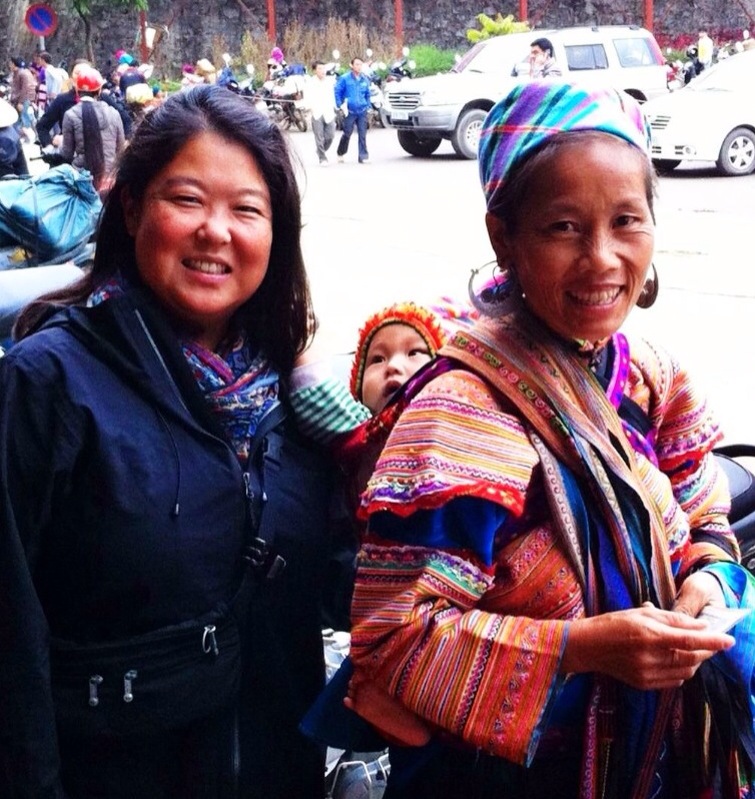
Photo opportunity with a Hmong
woman and baby.  (Baby is trying
to pull Akiko's hair out.)
We've seen lots of markets throughout our sabbatical, but Bac Ha's Sunday Market has to be one of our favorites because it is an actual working market for the local Hmong hill tribes who bring their produce, goods, clothing, and livestock from their mountain villages and spend the day selling, buying, trading, eating, drinking, and socializing with one another.

The major draw for tourists who come in bus loads from Sapa is the vibrant and intricate traditional clothing that the Hmong women are seen wearing at the market that makes this experience seem like we've been transported back in time, except for the ubiquitous presence of motorbikes that bring us back to reality...  

Because we were staying in Bac Ha, we got to the market before too many tour buses started arriving.  It started as a misty, rainy day but that didn't stop business.  We felt a little like intruders, however it was definitely worth experiencing.

View the photos and feel yourself transported to a different time and place!


A DIY Itinerary from Hanoi to Bac Ha, Vietnam

A popular tourist destination is the Lao Cai Province in northwestern Vietnam near the border of China where people from all over flock to view the beautiful rice terraces of Sapa, climb to the summit of Fansipan, and trek to many of the Hmong hill tribe villages in the mountains.  

As with many scenic places, the tour groups have practically taken over Sapa in the past few years and everything we've read cautions travelers to brace for overcrowded trails with a constant stream of persistent villagers trying to sell you something.

Transportation is always a challenge when trying to get around in the mountains, so it's no surprise that the majority of visitors to this region join one of the hundreds of organized tour groups departing from Hanoi.   


After much research, we decided to stick to a do-it-yourself itinerary.  The cost wasn't all that different, but we didn't want to feel rushed and confined to a group itinerary. We definitely have plans to spend a couple of days in Sapa, but we also desired a more quiet mountain town to settle in so we ended up choosing Bac Ha. 

Why Bac Ha? 
  • Fresh mountain air
  • Very friendly locals
  • Sunday market
  • Hiking
  • Not too many tourists stay overnight
  • Easy transportation from Lao Cai train station

Saturday, November 17, 2012

Hoi An, A Day at the Cooking School

Where best to take cooking classes than in the culinary capital of Vietnam?  There are lots of cooking schools here in Hoi An.  It seems almost every restaurant offers some kind of class for very cheap.  After perusing through a few offerings, we settled on the cooking class provided by a reputable restaurant in town called Dao Tien River with Chef de Cuisine, Viet. For $25/pp we got a tour through the Central Market to buy some ingredients, then a boat tour of Hoai River and watched the fishermen cast their nets and catch fish (!), then we returned to the restaurant to start cooking.

We had a full day.  You can see our blog entry on the market tour at the start of the day.  We didn't think we were lucky enough to have the chef to ourselves for 6 hours for $25/pp, but we also didn't expect 17 other French tourists who happened to be an hour late for the meeting time either!  Wandering through the market and delivering cooking instructions to 19 people is quite challenging.  As a former educator, I can relate, so we think Chef Viet did an amazing job of keeping us on track, especially since the menu was quite ambitious for a mixed crowd.


The entire upstairs of Dao Tien was set up as a cooking school with 19 stations.  2-3 people shared propane burners. We loved this cooking school because although it took a long time to get through the instructions of 4 dishes with such a large crowd, it was all hands-on.

Hoi An, Central Market and Foodie Finds

Cao lau (Hoi An noodles) street vendor is now open for business!  Of course, red plastic stools are a must for good street food. Everything she needs (including the stools) are carried in two baskets.
As far as we're concerned (and many will agree), Hoi An is the culinary capital of Vietnam.  4 centuries of trade with Japan, China, India, Netherlands, Portugal, etc. have resulted in taking the best culinary tips from these countries and incorporated into the best Vietnamese food we've had. Not to mention foods like Cao Lau that can only be made authentically in Hoi An using one of five well waters here.  Not to mention the BEST banh mi sandwich exists in Hoi An.  Never mind the other unique dishes specific to Hoi An and the greater Quang Nam Province, plus fresh seafood straight off the fishing boats in the South China Sea, that can keep us eating something different every day for the next year!

Here are lots of photos from the central market and a few of Hoi An's food specialties.

Day 200: Hoi An, Picturesque Port Town By The Sea


Hoi An could be one of the most picturesque places we've been to in a long time.  Being situated along the Hoai River that drains into the South China Sea, Hoi An was quite the bustling and cosmopolitan port trading town full of Japanese, Chinese, Dutch, Portuguese, and Indians who settled here for commerce.   The atmosphere quickly takes us back to those days with all the traditional architecture and quaint streets that could be a scene right out of a movie.  Ironically, the silting of the riverbed and the collapse of the Nguyen Rule in the 18th century that led to the demise of this port town is also the reason this place is so well-preserved because it was virtually ignored until it was declared a UNESCO world heritage site in 1999.  Since then, the stream of tourists haven't stopped and probably will continue to grow. 


Today, many of the original houses in Old Town have been turned into galleries, shops, restaurants, and bars for the tourists.   Yet, there's still a local feel (for now) as evidenced by the bustling central market and the traditional fishing that goes on in the Hoai River and ocean.  The night-scape of Old Town lit with lanterns reflecting off the surface of the river is unparalleled. 

Tuesday, November 13, 2012

Mekong Delta, The "Rice Bowl" of the World


The Mekong Delta in southern Vietnam is one of the world's richest agricultural regions, and according to our tour guide, just surpassed Thailand as the number one exporter of rice.  The climate, fertile soil, river waters, and centuries old cultivation techniques gives the Mekong a distinct advantage by being able to harvest rice 3 times a year.  Besides rice, there's a large commercial fishing industry and many tropical fruits grow in this fertile land.  Well, that sure sounded like a fifth grader encyclopedia report on the Mekong Delta (do they even do that in school anymore?  What's an encyclopedia? Ha, ha). 


Breakfast, pho ga, on our way to the
Mekong delta.
Our time in south Vietnam is short, but we didn't want to miss the opportunity to visit the delta, and especially the famous floating markets that grace many postcards from Vietnam.  However, the delta is a large area and is difficult to get around without a boat.  One can easily get lost amongst the rice fields, mangrove forests, stilt houses, floating houses, tributaries, and canals...never to be found again.  It reminds us somewhat of the Louisiana bayou.  To visit the Mekong properly, we should've probably devoted at least a week to explore the "bayou".  Unfortunately, we didn't have that kind of time so we did something very touristy.  After much deliberation, we joined an organized tour (*gasp*)!  We decided that it was the most efficient way to visit the delta. 


Saturday, November 10, 2012

Old Saigon Walking Tour

Monument of Ho Chi Minh
in front of the People's Committee
Building (City Hall).
Our starting point for our one-month trip through Vietnam is this bustling, sprawling metropolis in the southern part of Vietnam called Ho Chi Minh City (HCMC), formerly Saigon.  It's a big city divided into 19 urban districts with even more new developments underway.  We are staying in the historic district, also the backpacker district 1, where it is still known as Saigon. 

One of the best ways to get to know a city is to explore by foot.  We decided to follow the path of Lonely Planet Vietnam's self-guided Old Saigon walking tour that covers 4 kilometers and approximately 20 sites.  The book said it takes 3 hours, but it took us more like 5 hours for a couple of reasons.


Friday, November 9, 2012

Our Last Overland Border Crossing! Cambodia to Vietnam by Bus

Yesterday was our very final overland border crossing on our round-the-world trip!  We made it into Vietnam without any issue, visa or transporation-wise, thank goodness. 

The bus ride from Phnom Penh, Cambodia to Ho Chi Minh City, Vietnam took approximately 7 hours.  The roads were much better than our unpaved road bus ride from Siem Reap to Phnom Penh.  We heeded the advice of many and chose Mekong Express Limousine bus company at $13/pp (really, $12/pp but our hotel got a $1/pp commission) instead of the cheaper $5/pp bus rides.  The bus was clean and basic.  They gave us a free snack, water, and wet wipe.  Our luggage was tagged for security.  We stopped once for a 25-minute lunch break, right before the border crossing.  Weirdly, their 3 company goals were posted in Japanese inside the bus: (1) Avoid accidents (2) Reduce idling (3) Excellent customer service.  Hmmm.