Showing posts with label Transportation. Show all posts

Tuesday, December 11, 2012

A Very Important Visit

Today was a deeply personal trip.  Most of our Travel Sabbatical fans will not find this the least bit interesting or relevant, but our visit to Akiko's mom's gravesite was very important to us at the conclusion of our trip.  We think she was our guardian angel throughout our journey, keeping us safe from harm and illnesses, so we wanted to pay our respects and gratitude.

Akiko's mom, Yoko, was somewhat of an adventurous vagabond herself.  Akiko probably got the travel itch from her.  While living in the States, it was nothing for her parents to pack-up the station wagon and aimlessly drive off with the kids to explore the vast open road and national parks.  They also explored Southeast Asia during their 3 years spent in Singapore.  Although her full-time job in Tokyo prevented Yoko from traveling too much, she was an avid hiker and skier who liked to be in the mountains of Japan as often as possible.  Once retired, she was able to realize some of her dreams of trekking the Swiss Alps and witnessing the Matterhorn.  In fact, she went to Thailand way before we did and she's visited countries that we've not yet seen including Brazil, New Zealand, parts of the Canadian Rockies, etc.

So, it was with great shock and sadness that such an active person would be afflicted by Lou Gehrig's Disease or ALS, robbing her of her ability to move and eventually breathe.

1974?, Japan.

Monday, December 3, 2012

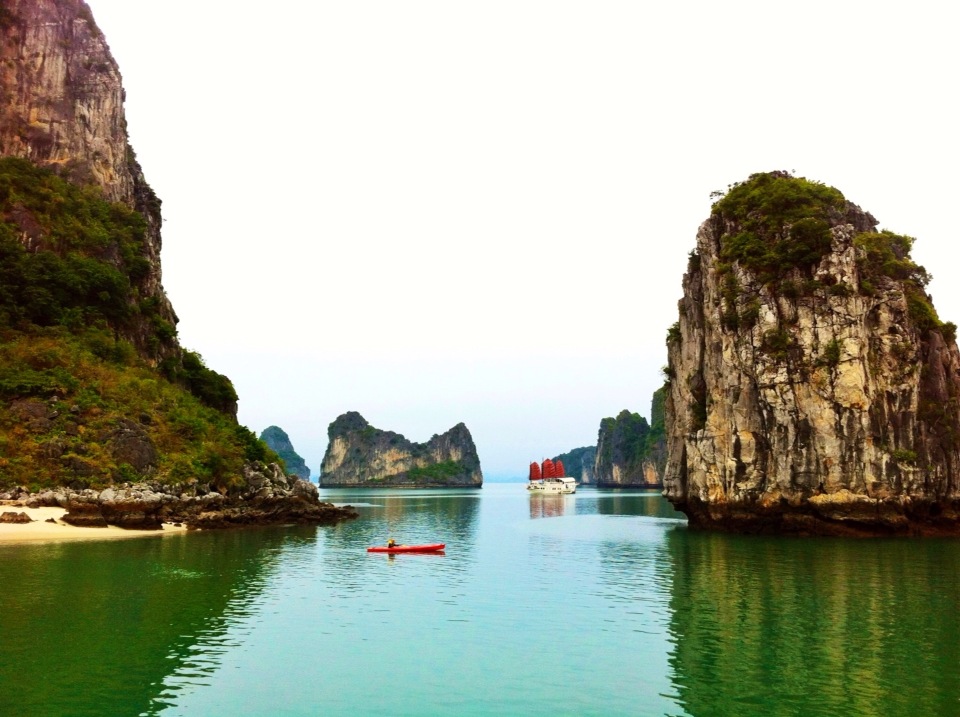
Cruising the Bai Tu Long Bay (Northeast of Halong Bay) with IndochinaJunk, Inc.


Halong Bay. Ha Long means "descending dragon".  Local legend says that a family of dragons descended onto the bay to protect Vietnam from invaders by spitting large jade and jewels into the water, forming thousands of island barriers against the invaders.  Afterwards, the dragons decided to stay and make these waters their home.  We think you will quickly see that the islands are reminiscent of dragons resting in the water.  

Apparently, we saved the best experience for last! We think this UNESCO World Heritage site and 7 New Wonders of Nature is one of the most stunning natural landscapes we've seen so far on our trip. Right up there with Plitvice Lakes in Croatia.  Yes, Machu Picchu (Peru), Angkor Wat (Cambodia), and the rice terraces of Sapa (Vietnam) were also awe-inspiring, but they are largely man-made wonders.  The two thousand limestone formations that pepper the northernmost bay of Vietnam was formed naturally over millions of years through erosion.  Even more amazing are all the hidden caves and lakes inside these hollow islands, where many have yet to be discovered.  

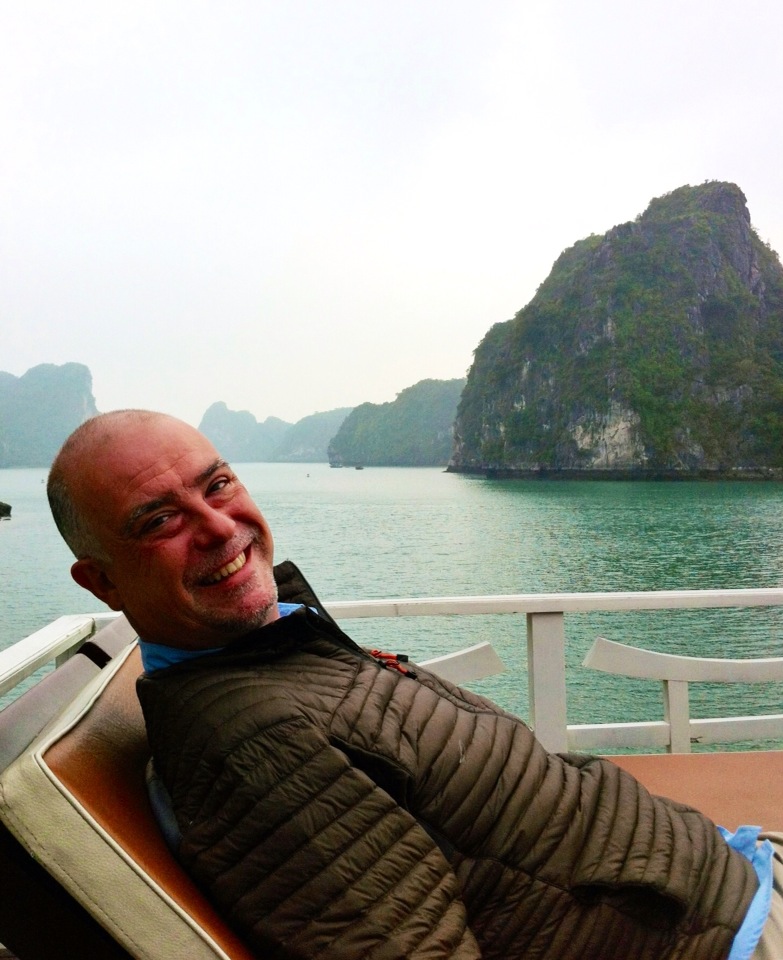
Mike relaxing on the top deck
of Dragon's Pearl I junk cruise.
As a result, Halong Bay was definitely on our "must-see" list, but we didn't know how to best experience this place.  Do we just find transportation to Halong Bay on our own, then find a day boat to take us around?  Do we sign-up for a one or two night cruise?  Should we just go to Cat Ba island, the backpacker capital, and admire the limestone formations from the shore?

Although we prefer DIY travels, this is one place that is best experienced by joining a tour.  Unfortunately, it seems every hotel and business in Hanoi has a cousin or brother-in-law that supposedly runs a tour.  There are soooooo many tour operators to Halong Bay that it is hard to know what's legitimate and what's not.  After much research, we decided on a 3-day/2-night cruise through the less touristed Bai Tu Long Bay just northeast of Halong Bay for a full and unhurried experience.  

We wrote an unsolicited infomercial on how we researched and selected Indochina Junk as well as other options at the end of this blog.*

Sunday, November 25, 2012

A DIY Itinerary from Hanoi to Bac Ha, Vietnam

A popular tourist destination is the Lao Cai Province in northwestern Vietnam near the border of China where people from all over flock to view the beautiful rice terraces of Sapa, climb to the summit of Fansipan, and trek to many of the Hmong hill tribe villages in the mountains.  

As with many scenic places, the tour groups have practically taken over Sapa in the past few years and everything we've read cautions travelers to brace for overcrowded trails with a constant stream of persistent villagers trying to sell you something.

Transportation is always a challenge when trying to get around in the mountains, so it's no surprise that the majority of visitors to this region join one of the hundreds of organized tour groups departing from Hanoi.   


After much research, we decided to stick to a do-it-yourself itinerary.  The cost wasn't all that different, but we didn't want to feel rushed and confined to a group itinerary. We definitely have plans to spend a couple of days in Sapa, but we also desired a more quiet mountain town to settle in so we ended up choosing Bac Ha. 

Why Bac Ha? 
  • Fresh mountain air
  • Very friendly locals
  • Sunday market
  • Hiking
  • Not too many tourists stay overnight
  • Easy transportation from Lao Cai train station

Saturday, November 17, 2012

Day 200: Hoi An, Picturesque Port Town By The Sea


Hoi An could be one of the most picturesque places we've been to in a long time.  Being situated along the Hoai River that drains into the South China Sea, Hoi An was quite the bustling and cosmopolitan port trading town full of Japanese, Chinese, Dutch, Portuguese, and Indians who settled here for commerce.   The atmosphere quickly takes us back to those days with all the traditional architecture and quaint streets that could be a scene right out of a movie.  Ironically, the silting of the riverbed and the collapse of the Nguyen Rule in the 18th century that led to the demise of this port town is also the reason this place is so well-preserved because it was virtually ignored until it was declared a UNESCO world heritage site in 1999.  Since then, the stream of tourists haven't stopped and probably will continue to grow. 


Today, many of the original houses in Old Town have been turned into galleries, shops, restaurants, and bars for the tourists.   Yet, there's still a local feel (for now) as evidenced by the bustling central market and the traditional fishing that goes on in the Hoai River and ocean.  The night-scape of Old Town lit with lanterns reflecting off the surface of the river is unparalleled. 

Friday, November 9, 2012

Our Last Overland Border Crossing! Cambodia to Vietnam by Bus

Yesterday was our very final overland border crossing on our round-the-world trip!  We made it into Vietnam without any issue, visa or transporation-wise, thank goodness. 

The bus ride from Phnom Penh, Cambodia to Ho Chi Minh City, Vietnam took approximately 7 hours.  The roads were much better than our unpaved road bus ride from Siem Reap to Phnom Penh.  We heeded the advice of many and chose Mekong Express Limousine bus company at $13/pp (really, $12/pp but our hotel got a $1/pp commission) instead of the cheaper $5/pp bus rides.  The bus was clean and basic.  They gave us a free snack, water, and wet wipe.  Our luggage was tagged for security.  We stopped once for a 25-minute lunch break, right before the border crossing.  Weirdly, their 3 company goals were posted in Japanese inside the bus: (1) Avoid accidents (2) Reduce idling (3) Excellent customer service.  Hmmm.

Tuesday, November 6, 2012

A Real Horror Story in Cambodia, The Khmer Rouge

There are very few places on earth where evidence of genocide is so well-preserved as they are at the Choeung Ek Killing Fields and the Tuol Sleng S-21 Prison in Cambodia.  

The Killing Fields.  Buddhist prayer
bracelets left on bamboo fence
surrounding a women and children's
mass grave.  The Killing Tree in
the background.
This isn't some morbid fascination in visiting haunted places with tortured souls. In fact, we were hesitant about going at all because we didn't know if we could handle the information.  However, they have been preserved to reveal the horrific story of the Khmer Rouge past to the world with hopes of never repeating this dark history again.  

Prior to our arrival in Cambodia, we did a lot of reading on the Khmer Rouge and the genocide that killed approximately 2 million or 25% of the country's population from 1975 to 1979.  One of the most poignant books was the autobiography, Surviving the Killing Fields, by Dr. Haing S. Ngor.  As a first-time actor, he actually won an Oscar for best-supporting actor for his role as Dith Pran in the movie, The Killing Fields.  

Dr. Haing S. Ngor's
autobiography.
We encourage you to learn more about the crazed-paranoid leader, Pol Pot and his communist party who had a social engineering policy of exterminating any evidence of any culture, capitalism, and religion from the face of Cambodia in favor of a self-sufficient agrarian utopia.  He succeeded in extermination but failed miserably in any sort of utopia.  More like hell on earth is what they created. 

Anyone that was a reminder of the former society (intellectuals, professionals, teachers, merchants, ethnic minorities, monks, even those wearing glasses because that indicated they could read and therefore, educated, etc.) were killed.  Those suspected of spying for the CIA (they'd never even heard of the CIA, but that didn't matter) were tortured, forced to falsely confess names of friends and family who were "also CIA spies", and summarily executed.  The worst torture was reserved for Khmer Rouge's own rank and file suspected of treason.  Many also died from being worked to death in the rice fields, starvation, and disease.

A calculated, mass-murder of your own people is difficult to fathom.  Yet, thanks to Khmer Rouge's own meticulous record-keeping and the lack of time in getting rid of the evidence when the Vietnamese liberation army drove them out, we were able to witness the remnants of this horror.  

Saturday, November 3, 2012

Temples at Angkor Archeological Park - Day 1 (Small Circuit)


Angkor and its temple ruins. 

Some say it is more impressive and mysterious than Machu Picchu in Peru.  Having had the privilege of visiting both,  Angkor is certainly more vast with Angkor Wat being the largest religious complex in the world.  It covers 400 square kilometers and was the center of the Khmer Empire for 600 years from 9th to 12th century while sustaining a population of over 100,000 Khmer inhabitants.  Both are mysterious and awe-inspiring.  Both, a testament to what was once advanced civilizations.  Khmers in Indochina. Incas in South America. 

Visiting Angkor Archeological Park has definitely been a must-do/must-see on our bucket list. For purposes of this blog, there's a lot of information on the internet and in books about the history, architecture, and explanation of the details of the temples.  Therefore, there really is no need to reiterate what's already out there.  For a brief overview, Angkor Archeological Park -WikiTravel site is quite explanatory. 

The recurring theme is that depending on which Khmer King built the temple, the temples were either dedicated to the Hindu deities of Shiva or Vishnu before the mid-12th century, while temples built by King Jayavarman VII - who converted to Buddhism - were dedicated to Buddha from mid-12th century on.  Although, we found carvings dedicated to both Hinduism and Buddhism in many of the temples as religious preferences waxed and waned amongst subsequent Kings after Jayavarman VII.

For anyone trying to organize how they should "tackle" the enormous park and dozens of temples, may we suggest an itinerary that doesn't leave you completely exhausted and immobilized after the first day?  

Friday, November 2, 2012

View of the Cambodian Countryside from a Bus

Lots of brahma cows in Cambodia
For our journey from Siem Reap to Phnom Penh, we really wanted to take the speed boat all the way down the Tonle Sap River, but since we are still on the tail end of the rainy season, the water levels dictate whether or not these boats can operate or not.  They couldn't guarantee that we would be able to ride the boat if the river was too flooded so we opted for the bus.  

What would 'normally' take 2 hours via a paved 4-lane interstate took more than 7 hours driving down a partially paved, mostly dirt, National Highway pocked full of potholes and standing water.  The road is shared by a myriad of other cars, trucks, and buses while mopeds and bicycles weave in and out of traffic on either side.  

Part "paved", mostly dirt, National Highway 6!
Whatever our bus driver gets paid doesn't seem enough compensation for his efforts in trying not to kill anyone during this white-knuckled driving for 7 hours straight.  In fact, the Siem Reap to Phnom Pehn route is notorious for accidents where travel guides warn about the cheaper bus operators driving recklessly, causing many injuries to passengers.  

Tuesday, October 30, 2012

Glad It's Over: Thai-Cambodia Overland Border Crossing


Today was yet another "adventurous" overland border crossing kind of day from Thailand to Cambodia.  This was right up there with the complicated, anxiety-provoking overland border crossing from Ecuador to Peru that we did back in May. 

We've read and heard a lot of chatter about the potential pitfalls and traveler nightmares of crossing the Cambodian border. Perhaps a visit to these sites for some inspiration:  Seat61, Poipet - WikiTravel, Cambodia: Poipet - A Warning

It's not that we were worried about whether or not immigration will let us in.  We already had our $25/pp Cambodian e-visas issued in advance.  It's all about getting across the border and to our destination without getting scammed...too much.  Basically, bribes and scams are rampant in this stereotypically rundown border town of Poipet, Cambodia, and oblivious tourists are the main target.  Though this may not be a true representation of Cambodia, it is a good representation of most corrupt border towns around the world, and Cambodia is no exception.

By now, you should know that we made it across the border to live and tell about our experience!  So, how did we do?  

Here's what our 13-hour travel day looked like...

Saturday, October 27, 2012

Return Trip from Ko Samui to Surat Thani Train Station and Bangkok

A week ago, our 18-hour "amazing race" from Bangkok to Lamai Beach in Ko Samui couldn't have gone more smoothly.  We thought the tour company providing bus transport directly from Surat Thani train station to the Seatran ferry terminal was a really good deal and without the headache of trying to find our own way, since we didn't see any public buses or taxis nearby the train station.

Our return voyage from Lamai Beach in Ko Samui to the Surat Thani train station to catch our 9:04 pm Express 84 overnight train back to Bangkok was a little more "on our own" and time consuming.  

We thought we would have plenty of time to catch our night train, so we thought we left our hotel really early at around 2 pm.  But it took over 5 hours.  We finally arrived at the Surat Thani train station at 7:30 pm, so remember to leave plenty of time for travel!  Here's how it went...

Sunday, October 21, 2012

The Amazing Race from Bangkok to Ko Samui, Thailand

One could fly directly from Bangkok to Ko Samui island and be sipping a piña colada on the beach before noon, but what would be the adventure in that when you could spend 18 hours traveling instead?

For the mid-range budget travelers that we are, flying is usually not an option.  Plus, the train system in Thailand is so good, 12-15 hours on an overnight train is a very pleasant experience.

Here's our amazing race of a day from Bangkok to Ko Samui.

First class cabins. Seat
converts into bunkbeds.
OVERNIGHT TRAIN
The trains in Thailand are awesome.  Online booking is very easy through www.thairailticket.com, although you could also walk up to the ticket counter and find a seat on one of the many trains departing daily.  For overnight travel, first class private cabins book up very quickly in advance, so we made these reservations about 2-3 weeks prior to our travel date.  There is more availability for second class air-conditioned cars; but we would advise you avoid the second class fan-only cars.  Besides being hot, the windows are left wide open and offers 'free boarding' for mosquitos. 

The overnight express train (express, because it skips stations; but definitely not due to speed) in first class ($43/pp) from Bangkok left at 1930 and was scheduled to arrive at Surat Thani station at 0706 the next morning.  This was our third overnight train in Thailand, and we've yet to arrive anywhere on time.  The 11.5 hour ride took more like 12.5 hours.  

In the past...

Friday, October 5, 2012

Tips For A Successful Visit to Jerusalem

While we originally thought a week in Jerusalem was excessive, we're glad for the extra days we had to explore the city because we never intended to visit right in the middle of the Jewish holidays - Yom Kippur and Sukkot - as well as the Sabbath, where everything literally shuts down.  Although it was nice to have a few "forced" days of rest right alongside the locals celebrating their holidays...the lack of public transportation and closed businesses made us think of other nice-to-have-known tips for visiting Jerusalem.


Saturday, September 29, 2012

Safe Arrival in Jerusalem, Israel

With all the current extremist tensions going on in the Middle East, embassy attacks around the world, and Israel ramping up to protect themselves from Iran's nuclear "program", we knew security would be tight at Ben Gurion Tel Aviv Airport. So, we are happy to announce that we safely arrived in Jerusalem without any problems.  In fact it was one of the fastest and smoothest customs, security, and immigration processes.  Of course we landed at midnight and there weren't too many people arriving at that time so that probably helped.  We were pleasantly surprised that there were no lengthy security checkpoints and "interrogations" by the immigration officers.

We were quickly out of the international arrival lobby and on our way to Jerusalem.  We easily found the Nasher Taxi Shuttle service, right outside baggage claims.  These 10-seater vans drop passengers off in front of their home or hotel, 24/7 for 62 shekels/pp.  We got on the one going towards the Bak'a neighborhood of Jerusalem, gave them our address of the apartment rented through Airbnb, and we were on our way!  It's a much better option than taking a taxi for 200-300 shekels.  Although, we've been told that the shuttles sometimes deny taking passengers to the Muslim-based, East Jerusalem addresses.  Knowing this, we made sure to find an apartment in West Jerusalem.  

Jeff, our Airbnb host who is American living in Jerusalem, offered to let us in the apartment when we arrived in the middle of the night.  Isn't that the best service, ever?  Otherwise, we would've had to find a hotel at 2 am, then move to our apartment the next day.  

The studio apartment is very cute, cozy, comfortable, and quiet. It has air-conditioning, a huge plus in this Middle Eastern heat.  We've heard more American English being spoken by residents in this Bak'a neighborhood than we have anywhere else in our entire trip thus far.  It almost feels like home, except that everything is written in Hebrew without a single English translation, so thank goodness people can communicate in English, because we sure can't read anything around here!

Door to our studio apartment on Shimshon Street in Bak'a neighborhood in West Jerusalem.
Lovely private patio outside of our room.  Also a great place for hanging our laundry in this Middle Eastern heat! 
A really nice bike and walking path near the apartment. 
Digging into a falafel sandwich! 

We anticipate an enjoyable stay in Jerusalem! 

Friday, September 21, 2012

2nd Day in Istanbul: Full of Really Old Things


We've been seeing a lot of history and ancient things on our travels, but we knew we were REALLY going to see some old and grand things when we got to Istanbul! 

As the center of many empires that have come and gone since the beginning of time, Istanbul offers an overwhelming amount of history and culture.  Ruins from ancient cities share prime real estate with modern buildings.  There are so many ancient artifacts, they are strewn all over the grounds of the archeological museum.  Every structure is a living history and testament to the power and grandeur that ruled this part of the world. 

Saturday, September 15, 2012

Weirdest Bus Ride from Skopje to Sofia, Ever


On our next journey across the Balkans, we boarded a 5-hour bus ride to Sofia, Bulgaria.  The bus was nice enough, clean, and comfortable.  The scenery was cloudy and rainy across the beautiful landscapes of the Balkans countryside. 


However, by the looks of him, we think the bus driver was either very sick, very hungover, or still half-drunk.  This didn't seem too far fetched after we witnessed a group of bus personnel in uniform at the Ohrid bus station the other day, doing shots of brandy with their espressos at 7 in the morning!  We have no idea if they were off-duty (we hope) or not, but it didn't leave a warm and fuzzy feeling.

Back to our bus headed to Sofia...

Thursday, September 13, 2012

5-Days of R&R at Lake Ohrid, Macedonia


People around here call Lake Ohrid, the Macedonian Riviera, as it's the closest Macedonia will ever get to having a coastline.  The lake is one of the oldest and deepest in Europe, sharing it with Albania on the southwestern side.  It appears many Europeans have discovered this beautiful lake getaway so the small town is quite built-up with hotels and restaurants to accommodate the tourists.  Fortunately for us, we got here just in time to see the August holiday crowd pack-up and go home, leaving us to enjoy the serenity of the crystal clear waters surrounded by the Dinaric Alps mountain range undisturbed, except for a few lingering retirees. 

Monday, September 10, 2012

Quirks and Difficulties of Traveling Through the Balkans


From Sarajevo, we literally didn't have an exit plan because we couldn't make a decision on which direction to head.  We thought about going south towards Mostar, Bosnia and Hercegovina (BiH), then Montenegro, then Albania, but we found out that Albania does not allow public transportation to cross its borders from some of the other Balkan states.  It didn't sound like something we wanted to hassle with.

We considered taking a more off-the-beaten-path route, but again, cross-country transportation outside of major cities is sparse and lodging unreliable.  

We really wanted to raft down the super-deep Tara Canyon river in Montenegro, then go east through Kosovo, then Serbia, but getting to and out of Tara Canyon sounded like it would take many extra days.  Also, we're very glad we didn't do this route because Serbia would not have allowed entry had we gone through Kosovo first.  It has to do with territorial disputes about Serbia's claim over Kosovo, and it's complicated, but Serbia considers going through Kosovo first, an illegal border crossing.

Basically, we've considered several different itineraries each time, but most are eliminated due to transportation or border crossing issues.  The places we've been during the past 2 weeks represent the path of least resistance.

Sunday, September 2, 2012

Train Ride From Zagreb to Sarajevo

We found out that taking the train is a pretty simple way of getting from Zagreb, Croatia to Sarajevo, Bosnia and Hercegovina (BiH).  At the main train terminal in Zagreb, we checked the published departure schedule, looking for the train that goes to Sarajevo.  It was difficult to find within the fine print, but saw there are 2 departures daily.  The first one leaves daily at 8:53 am with a final destination to Ploce, stopping at Sarajevo along the way.  The other is an overnight train.  We read that the Croatian and BiH scenery is not to be missed, and the numerous interruptions by ticket verifiers, passport controls, customs personnel, etc. would prevent anyone from getting much sleep anyway; so we chose to travel during the daytime.  

Zagreb, Croatia: A Tourist-Friendly Destination

We just left Zagreb, the capital city of Croatia, and are heading to Sarajevo, Bosnia and Hercegovina on a 10 hour train ride through the country.  

Here are some reflections on Zagreb and Croatia as a whole.  First, gotta love a language that makes full use of the letter "Z"!  Never seen so many words with "Z" in it.  

Not having done much research on Croatia in advance, it has been a fun week discovering new things as it unfolds.  For example, who knew that the necktie originated in Croatia?  Yup.  The Croatian army sported red ties called cravats, as part of their uniform.  When the French saw this, they immediately loved it and took the tie as a fashion statement (go figure).  The rest is history.  Apparently, the ballpoint pen was also invented by a Croat.   Akiko, being sort of a pen connoisseur, appreciates this little fact.  Truffles are also abundant in Croatia.  We got to sample some in our dishes, but this would've been a moment where we wished we could actually buy souvenirs to take home.  They sold many truffle related food products such as truffle oil, truffle paste, truffle essence, truffle salt, etc. 

Friday, August 31, 2012

Plitvice Lakes in Croatia, the Most Beautiful Collection of Natural Lakes

Dear Reader, have you ever heard of Plitvice Lakes National Park in Croatia? If so, you have been in on one of the most beautiful secrets of nature. We faintly knew of its existence only because Akiko remembered a picture of Plitvice burned into her mind after a random, mindless, perusal session of Pinterest (Ha! Pinterest is not a complete waste of time after all...case closed).

TRANSPORTATION AND LODGING
When we arrived in Croatia, we didn't have any particular pre-planned destinations, and Akiko happened to remember something about these lakes, so we decided to head there from Zagreb. After some research, we discovered that it is in the middle of Croatia, and is a difficult place to get to by public transportation. In fact, there are none, except for a bus to/from Zagreb that may or may not stop once a day, and not anywhere near the entrance to the National Park. It seemed too unreliable. We had no intention of renting a car at anytime during our travels, but in spite of the extra cost, it seemed to be the best option. By having a car, it also opened up more options for cheaper lodging farther away from the National Park, since we could just drive and park there.