Showing posts with label Japan - Kyoto. Show all posts

Saturday, June 2, 2012

DAY 29: KYOTO Part 4 - The Imperial Palace

Previous Post, "DAY 28: KYOTO Part 3 - Nighttime in the Gion District"

We finished our short trip to Kyoto by visiting the Kyoto Imperial Palace - the former residence of the Imperial Family until 1868 when they moved to their present palace in Tokyo.  As mentioned before, visits can only occur by appointment, usually reserved for foreign visitors.  One Japanese national is allowed in per group to serve as an interpreter.  There are 2 English speaking tours offered on most weekdays at 10 am and 4 pm, which last about an hour.  The reservation process is relatively easy through the Imperial Household Agency website. Be sure to bring your appointment confirmation to show the guards at the gate, and also your passports.

(Okurumayose: awning for where the carriages dropped off guests)
(Shodaibunoma: waiting hall for visiting guests; Gekkamon Gate in the distance)
(Shodaibunoma: interior with paintings of cranes on the screens)
(Jomeimon Gate: inspired by Chinese architecture colors of vermillion orange; Shishinden: the most important building on palace grounds used for important events such as state and enthronement (coronation) ceremonies.)
(Wood roofs made of layers and layers of cedar bark.  It is resistant to water, yet allows roof to breathe. Roofs last about 30 years and it takes 25 years to re-roof all the buildings of the Imperial Palace grounds.)
(Shunkoden: building that formerly housed one of the 3 sacred Imperial Treasures of Japan - a mirror)
(Emperor's living quarters: the Emperor was carried everywhere because he was not allowed to touch the ground, except for in his living quarters where the ground was covered in ceramic.  The center tented area was his main sitting area on thick tatami mats.  Whenever he welcomed visitors, a screen came down in between them so as to not be able to directly view the Emperor.)
(Oikeniwa Garden)
(A Crane was hunting for food in the Oikeniwa Garden pond.  It was so still, it almost looked fake until it started moving towards something, caught it, and flew off.)
(Gonaitei Garden)
(Gardeners manicuring the trees)
(A rock garden, even in the women's restroom at the Imperial Palace!)

Click here to view more photos of Kyoto.

DAY 28: KYOTO Part 3 - Nighttime in the Gion District

Previous Post "DAY 28: KYOTO Part 2 - A Day of Sightseeing"

The best place to enjoy an evening in Kyoto is the Gion District.  Gion is Kyoto's geisha district filled with shops, exclusive restaurants, and tea houses where geiko (what geishas are called in Kyoto) and maiko (geiko-in-training) entertain.  Many of the traditional wooden "machiya" merchant structures can be seen here.  The most popular street is Hanami-koji Street. Another scenic Gion area is Shirakawa Area along the Shirakawa Canal.  There are many exclusive restaurants and tea houses overlooking the canal, lined by beautiful willow trees.

(top to bottom: traditional wooden machiya building in Gion District; geiko being chased by paparazzi; shopping in Gion - expensive wooden slippers, sushi made from cloth)

According to the Kyoto Guide magazine, there are only 190 geikos and 90 maikos in Kyoto, making a geiko/maiko sighting similar to witnessing a famous actor/actress sighting in Los Angeles.  Unfortunately, we saw paparazzi-esque cameramen camped out in front of the tea houses, obnoxiously running after the geiko/maiko for a photo.   A maiko or geiko encountered should be treated with respect (Japanese were bowing to them as they walked by), and taking a photo should be done without disruption.  

(top to bottom: along the Shirakawa Canal; we saw 3 geikos total; kabuki theatre in Gion)

There is no equivalent or anything close to a geisha in the western world, so it is difficult to explain their elite place and respect in Japanese society.  They are highly trained and educated entertainers of Japanese traditional art.  They are not prostitutes.  Confusion may have come about after WWII when women prostituted themselves as 'geisha-girls' to American GIs. 

(top to bottom: restaurants and tea houses along the Kamogawa River; narrow street down Pontocho; in front of the restaurant we ate in)

Another picturesque area is Pontocho, a very narrow street parallel to the Kamogawa River, full of more restaurants and tea houses.  We found a restaurant serving a course menu for a reasonable price in Pontocho.  We sat on the tatami floors upstairs while we ate our 5-course Obanzai meal.  Obanzai ryouri is akin to Kyoto home style cooking - less formal and haute than keiseki cuisine.  For the first 4 courses, we all had the same dishes, but was able to select from 5 options for our main entree.  Akiko went with the boiled tofu (Kyoto is famous for its tofu), Mike went with the kurobuta (pork), and everyone else chose the sirloin steak.  


NEXT POST:  Kyoto Imperial Palace

Click here to view more photos of Kyoto.

DAY 28: KYOTO Part 2 - A Day of Sightseeing

Previous Post "DAY 28: KYOTO Part 1 - Planning a Trip for a Party of Six"

Kyoto was the capital city of Japan from 794 to 1869, and is the cultural center of Japan.  Kyoto-ites go along way to preserve many of the cultural traditions of Japan that originated and developed there. It is said that during World War II, the United States considered targeting Kyoto with an atomic bomb; however, the city was removed from the list of targets and replaced by Nagasaki.  As a result, Kyoto is one of the few Japanese cities that still have alot of prewar buildings and townhouses.

A quick visit straight out of the Kyoto train station is Nijo Castle in the heart of the city.  Nijo Castle was built as the residence for the Tokugawa Shogun in 1603. Nijo Castle was used by the 15th Tokugawa Shogun, Yoshinobu, in 1867 to declare the return of authority back to the Imperial Family from military dictatorship since 1192.  A small entrance fee gains access to the castle grounds, gardens, and a walk through the actual castle where the wooden floor boards of the hallways were designed to squeak on purpose to alert the residents of anyone approaching.  No interior photographs are allowed.  

(The entrance to Nijo Castle, castle grounds)

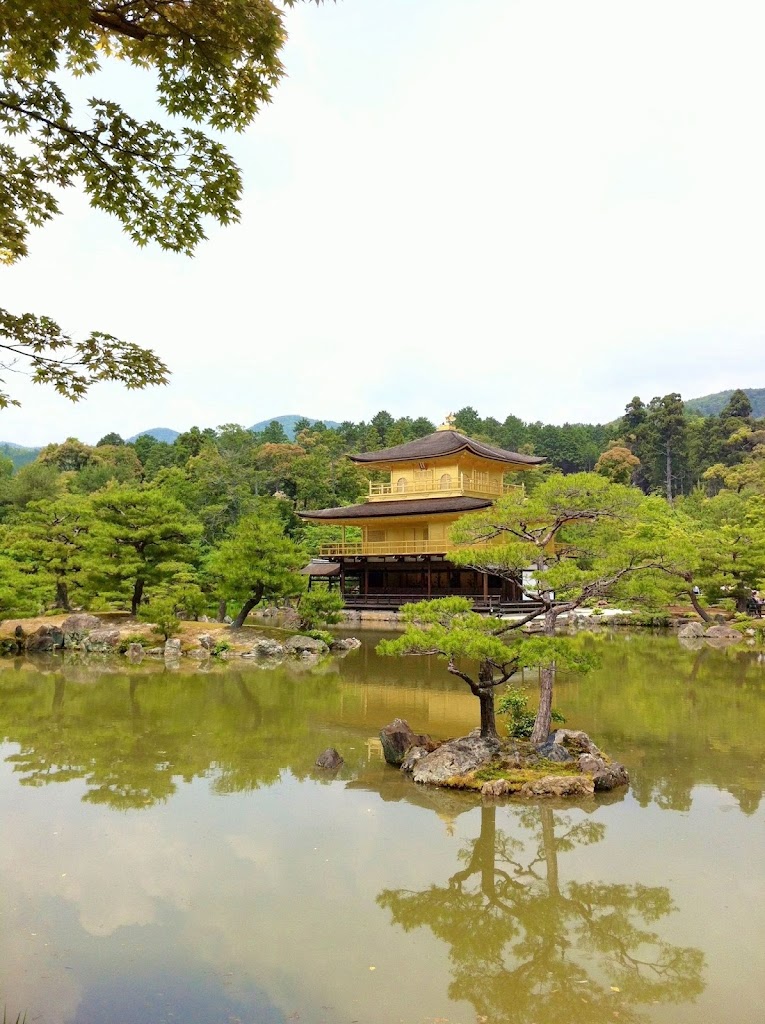
Next, we made our way to Kinkaku-ji (Golden Pavilion) in the northern part of the city.  The Golden Pavilion is a Buddhist hall containing relics of Buddha on the temple grounds of Rokuon-ji.  This was originally a retirement villa in 1397 for the 3rd Shogun, Ashikaga Yoshimitsu, but was donated as a Buddhist temple after his death.  Kinkaku-ji is named because the top 2 floors are completely covered in gold leaf  and the interior of the 3rd floor is also covered in gold leaf.  Other sites on the grounds include a Buddhist temple with a century old tree in the shape of a boat.  There is also a tea house used for tea ceremonies, watering hole for the shogun, waterfalls, statues, etc.  Kinkaku-ji is a very popular attraction so it tends to get very crowded; although the walk around the grounds is very nice.  

(the Golden Pavilion)

(centuries old tree that has been shaped into a ship at Kinkaku-ji)

Very close to Kinkaku-ji is one of my favorite places, the rock garden at Ryoan-ji.  Again, this was an aristocratic villa but became a Zen Buddhist temple in 1450.  The famous rock garden is interesting.  It consists of 15 rocks laid out in small groups, but at least one rock cannot be seen from any vantage point.  There are nice walking trails around the temple grounds.  We got a good close up view of a large cedar tree.  Cedar bark is used to build the roofs on many of the traditional Japanese buildings as it tends to be oily to resist water and bugs.  

(the rock garden at Ryoan-ji)

(a small replica of the rock garden)

We drove through the Kyoto countryside on our way to Arashiyama (Storm Mountain), where we grabbed some lunch.  We were mesmerized by the vegetable vending machine in the middle of nowhere!  Looks like the farmers can put their veggies up for sale without having to stick around at a farmers' stand.  Ingenious.  

(veggie vending machine)

(the gardens of Tenryu-Ji Temple)

In Arashiyama is Tenryu-ji ("Heaven Dragon" Temple), another Buddhist temple built in 1339 by Shogun Ashikaga Takauji.   The gardens of Tenryu-ji has survived centuries of fires and wars, and is beautiful.  However, our main objective was to make the 20 minute hike through the Sagano bamboo grove, down to the Hozu River that connects to the Katsura River, and back to the Tenryu-ji Temple.

(in the bamboo forest)

(Hozu River in Arashiyama)

(a Merry Maids van! House in neighborhood of Arashiyama)

Here is the shortest history of Japan, ever:  Japan was heavily influenced by China, and inhabitants have been living on these island since the ice age.  By the late 7th century, the emperor ruled Japan and became a civilized centralized kingdom.  Nara became the first permanent capital of Japan in 710.  However, Emperor Kammu moved the capital to Kyoto in 794.  Outside of Kyoto, the Emperor's influence began to weaken when rich, aristocratic landowners began hiring private armies called samurai.  The samurais of powerful rival families fought in civil wars, until the Minamoto clan won.  1192, the Emperor gave Minamoto Yoritomo, the title of Shogun and the shogun ruled Japan as a military dictatorship in the name of the Emperor until 1869.  The Emperor was largely a spiritual and cultural figurehead.  There were many shogun rulers over the centuries - some gained this title due to hereditary, some due to military coup, etc.  For over 200 years, Japan flourished under peaceful times during the Tokugawa Shogunate Period where the shoguns went to great lengths to maintain order and isolation from the rest of the world.  However, Japan could not stay isolated forever.  In 1853, Commodore Perry of the United States forced trade with Japan.  Treaties unfair to Japan were agreed to because Japan's armed forces were no match to foreign invasion.  The shogun lost face because of his weakness, causing civil war between shogun supporters and those that wanted the Emperor restored as ruler.  In 1867, Tokugawa Shogun, Yoshinobu returned authority back to Emperor Meiji, bringing in the Meiji Restoration Period where Japan modernized from a primitive, agricultural, feudal system to an industrialized country in just a few years.  The Imperial family and the capital also moved to Tokyo.  After World War II, the Emperor renounced his power and a constitutional monarchy was established during the American occupation.  The current government of Japan has a Parliament with the Prime Minister as head of Japan, and the Emperor as a ceremonial figurehead without powers. 

NEXT POST:  Kyoto At Night - Gion District and Dinner at Pontocho

Click here to view more photos of Kyoto.

DAY 28: KYOTO Part 1 - Planning a Trip for a Party of Six

This is for anyone looking for tips on how we coordinated an overnight trip to Kyoto from Tokyo for a group of six.  A major expense in Japan is transportation.  The most efficient way to get to Kyoto is by Shinkansen (bullet train), which costs ~$350 round trip.  So, most foreigners apply in advance for a Japan Rail Pass, which provides unlimited access to the trains operated by Japan Railways for a consecutive time period of your choice - 7, 14, or 21 days.  As comparison, the 7-day Rail Pass for Ordinary class costs about $360 - an excellent deal if riding the Shinkansen multiple times within this time period to get around Japan.  

For us, we were making one overnight trip, then returning to Tokyo, so although the Rail Pass option would have benefited us slightly, it wouldn't have been the biggest savings.  The information that helped me decide NOT to get a Rail Pass was the excellent package deals offered through the Japan Travel Bureau promotions, "Japan I Can".   For an overnight trip to Kyoto including Shinkansen round trip tickets and a hotel cost ~$250/pp.  The hotel alone would have cost at least $100/night/pp if we tried to book it on our own.  The site offered many hotel options, including Japanese Ryokan style versus Western style.  We ended up going with the western style Karasuma Kyoto Hotel for its walking distancd to the Gion District.  

Our train/hotel package had us leaving Tokyo Station at 6:30 am, arriving in Kyoto at 9:15 am to get a full day of sightseeing in.  We were scheduled to depart the next day at 2 pm, getting us back to Tokyo around 5 pm.

(Literally, dozens of different kinds of bento boxes are available to be eaten on the Shinkansen!  This was my breakfast.)

Another transportation consideration is once you get to Kyoto, will you be sightseeing via public transportation, taxi, or join a tour group?  There are over 1600 buddhist temples and 400 Shinto shrines.   Kyoto is a huge metropolis in a valley, flanked by 2 mountains. Many of the more significant sights are spread out throughout the city and into the hillsides, and getting from one place to another is challenging when under a time crunch.  Public transportation is a great option if you have plenty of time to figure out the train and bus system, with time allowances for walking.  Taxis are everywhere, but can be expensive, and can only seat up to 4 people.  Group tours are a good deal, if you like a cookie cutter tour.

(We've arrived!  Kyoto Station)

The best option with our limited time and group size was to hire a private taxi for the day to take us around Kyoto.  I found a great deal.  Mr. Naoki Doi is an owner of a taxi company - Doi Taxi, offering private tours in English for a group of up to 6 people!   First of all, having a van for a taxi, large enough to hold 6 passengers is unheard of in Japan.  We would've had to split up into 2 cars, otherwise.  Secondly, the fact that Mr. Doi goes into the sights himself and provides a tour in English was outstanding.  Thirdly, we were able to leave our belongings in the car throughout the day.  Fourthly, the cost was very reasonable.  At ~$70/hour, we hired him for 6 hours and were able to thoroughly see 4 sights with a lunch break in between, delivering us to the front steps of our hotel at the end.    

(All six of us comfortable in our cab-for-hire)

4 sights doesn't seem like much in 6 hours, but the locations are spread out, and requires a lot of walking on the grounds of each of the temples and shrines.  For our itinerary, we mixed it up by starting with a castle (Nijo-jo), then a beautiful golden temple (Kinkaku-ji), a zen rock garden at a temple (Ryoan-ji), then some nature by walking through the bamboo forest at the Tenryu-ji Temple in Arashi Mountain.  After being dropped off at the hotel, we rested our weary feet for a couple of hours, then walked about 15 minutes to the Gion District across the Kamogawa River for the evening in hopes of seeing some geishas (or geiko, as they are called in Kyoto).

A request by one of the group members was to eat a keiseki ryouri, or a traditional Japanese multi-course haute cuisine.   An excellent place to try this would be in Kyoto where it all started about 500 years ago.   First, most Japanese ryokan style lodging includes meals, and a form of keiseki cuisine would most likely be served for dinner.  For the hotels without a meal plan, there are keiseki restaurants which usually require an advanced reservation and the high price tag of the meal is representative of the fresh and seasonal ingredients used - some ingredients which may not be entirely suitable for the American palate. Our group is food adventurous, but needing a reservation, the cost, and not knowing all the etiquette around a keiseki meal, we opted to leave our evening open for whatever restaurant interested us at the time. 

Since we had some time the next day for a little more sightseeing, I made an appointment for the 10 am English speaking tour of the Kyoto Imperial Palace grounds - an experience that many Japanese are unable to fulfill as it is closed off to Japanese nationals except for twice a year and by special request.  To make advanced reservations for the free 1-hour tour, go to the official Imperial Household Agency site.  

An excellent resource for English speakers is Kyoto Guide (www.kyotoguide.com) - a monthly magazine on up-to-date Kyoto travel and tourism information that has been around since 1987!  A new issue is published on the 1st of each month, and includes: monthly highlights and events; info on English speaking day tours by bus or walking tours; places to shop, stay, and dine; detailed maps in English; transportation maps in English (bus, train, subway, taxi); recommended sightseeing routes; yseful tourist info on money, internet access, airport access, bicycle rental, shrine prayer etiquette, maiko/geiko district, etc.

NEXT POST: A Day Sightseeing in Kyoto

Click here to view more photos of Kyoto.