Saturday, May 26, 2012

Sasebo Burger in Tokyo

Love Japanese food but sometimes, a taste of home is what the doctor ordered. Sasebo Burgers are a special kind of burger since 1950 when an American GI taught some Japanese how to make a real American burger. Typically, a hamburger conjures up an image of a hamburger steak with gravy, in Japan.

A Sasebo burger has the following characteristics. There are several burger joints around Tokyo that serve a burger in this style:

1. Fresh/handmade
2. Use only Japanese beef
3. Soft bun
4. Special mayonnaise with 9 spices
5. High quality egg for the fried egg
6. Cheddar cheese
7. 5 mm cut thick bacon from Kyushu, Japan
8. Lots of veggies (lettuce, tomato, onion)
9. Instructions for eating include pressing the burger down before eating to ensure all the sauce/juices are mixed together and throughout the burger

www.sasebo-burger.jp


Friday, May 25, 2012

Day 24: Tamura Sake Brewery

At 190 years old, Tamura Shuzojo (田村酒造所) (www.seishu-kasen.com) is the oldest sake brewery in the Tokyo area.  It is located approximately 1-hour by train (on Chuo JR line towards Ome), west of Tokyo in a suburb called Fussa.  The Yokota Air Force base is located nearby.  

My (Akiko) dad inquired about visiting the facility, and we were granted a private tour for the 7 of us.  They were very worried about the language barrier, as they do not speak any English, so we reassured them that between me and my dad, we should be able to translate for them.  As it turns out, translating is a tough job, especially when I am also unfamiliar with the process, but I think the group got the general idea!  During the 1-hour tour, we were shown the areas depicted in the diagram below, ending with a tasting, of course...


(The 26 mile aqueduct and Tamura's private intake pump that looks like a fire hydrant)
Since 1822, the Tamura family has been making sake in the Fussa village.  Currently, the 16th generation Tamura is the sake master.  The location of the brewery is largely in part due to the spring water source.  Water from the same well dug 190 years ago is still being used to make the sake.  In fact, their brand name is called Kasen, or 'spring of joy'.  A 26 mile aqueduct diverting water from the Tama River was constructed in 7 months during the Edo Period (1653 AD).  This aqueduct is now a historical site.  This was the main drinking water and water supply for daily living in this region.  33 intake watersheds off of the main aqueduct were created to divert the water through the neighborhoods.  Only 2 of them are privately owned, including the intake that goes to the Tamura property.  In the olden days, this watershed helped turn the watermill used to grind and polish the rice kernels for sake.  

(Old watershed through Tamura's property)

(Former water mill where rice kernels were polished down by the stones)

Albeit the difference in ingredients, the sake brewing process is more similar to beer than wine.  

RICE:  special brown rice for making sake called shuzo kotekimai is larger, stronger, and contains less protein and lipids than rice that is eaten.  The rice is first polished down to remove the outer bran layer to maximize the central, starchy component of the grain called shinpaku.  The amount of the outer layer polished off affects the quality of the sake.  The more polished = higher quality.  Typically, about 30% of the outer layer is removed for sake, but at Tamura Sake Brewery, they usually remove 55% of the bran, and up to 70% for the most premium brands.  

KOJI: The rice is washed, soaked, then steamed.  The steamed rice is then inoculated for 2 days with the mold spore, Aspergillus oryzae, or koji in Japanese.  Unlike beer where the malt naturally has enzymes to convert the starch to sugar (as food for the yeast), rice does not naturally have these enzymes.  The koji spores provide the needed enzymes to convert the rice starch into sugar.  

(original 190 year old brewery building with old wooden beams without nails. No damage from the most recent major earthquake in 2011.)

YEAST: While the koji is working, yeast is added to the koji/rice/water mixture, converting the sugar into alcohol.  This is done over 3 weeks in tanks at a cool temperature.  The premium sakes are deliberately fermented slowly at a very low temperature over a longer period of time (5 weeks).  

PRESSING:  The sake is filtered through a press by removing the solids.  

PASTEURIZATION:  The sake is then pasteurized at 65 degrees Celsius (149 degrees Fahrenheit) and bottled for longer storage.  Unpasteurized sake is called namazake, and should be consumed relatively quickly or else it will spoil.  All sake should be consumed within a year of bottling. It does not age well like wine.


We also took a tour of the grounds full of beautiful trees and plants.  2 very large cedar trees were planted 700-800 years ago, and still serves to keep the brewery building cool from the summer heat.   

At the end, we were able to sample several grades of sake, and of course, we all made purchases!  


If anyone is interested in making a trip to this sake brewery, my suggestion is to have a Japanese speaking person call, make a reservation, and bring along an interpreter.  

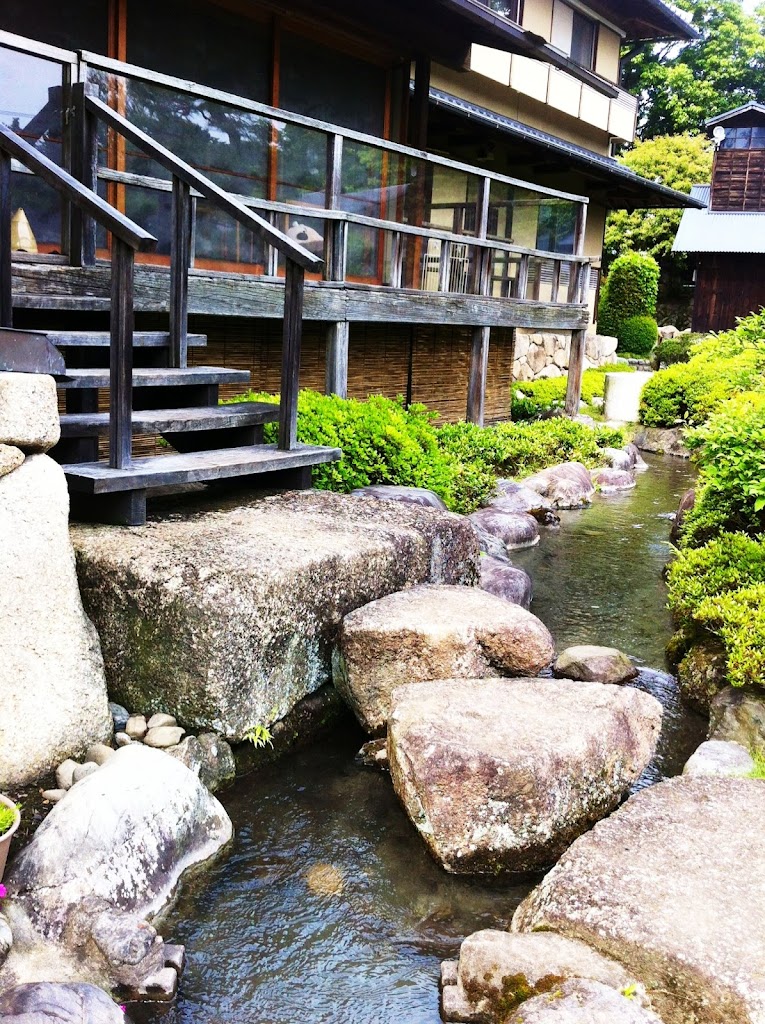
(the original well)

Thursday, May 24, 2012

Day 23: Yakatabune (Japanese house boat) Dinner Cruise in Tokyo Bay

After our day trip to Kamakura, we headed towards the north part of Tokyo Bay, where we boarded a Yakatabune (traditional Japanese house boat) dinner cruise down the Sumida River and Tokyo Bay.  Again, our friend, Kaori Takeuchi-San arranged for all this as none of us had done anything like this before.  


Apparently, it is a popular activity, written in CNNGo.com in an article titled "Yakatabune: Party Boats Ply the Bay" by Julian Ryall.  There are many companies operating a similar dinner cruise, serving different types of food.  All of them are all-you-can-eat-and-drink (beer/cocktails) for a set price for a 2 - 2.5 hour boat ride.  Many operations charge around ¥10,000 ($125/pp), depending on the type of food served.  Ours was a steal at ¥4900 ($60/pp) through a company called Edo-Mae Kisen, operating near the Shin-Kiba train station.  


Our boat served what is called monjayaki.  It is a communal food that usually includes cabbage, meat, and a loose batter; where everyone cooks and eats monja off of a hot plate; and is a native dish to Tokyo.  Here was our menu (provided in English).  They even gave us cooking instructions in English.


Our first monja course was a little strange for some of us.  It included fish roe and mochi (glutinous rice).  The second monja was a little more palatable with cheese and eggplant as the main items in the batter.  We also ordered a similar dish called okonomiyaki, which is very similar to monjayaki but it is cooked until the batter is firmer.  It is sometimes referred to as a savory Japanese pancake.   We also had yakisoba, or fried noodles.


Everyone's favorite was the shrimp doria, which is a rice dish that tasted like a very creamy, cheesy, risotto!  We ended the night with the chocolate banana dessert cooked on the hot plate, starting with butter, then chopped up bananas, coconut, chocolate, and cornflakes!  

We were pretty busy cooking our own food, but was also able to enjoy the Tokyo skyline at night and the Rainbow Bridge.  Although it was difficult for us westerners to sit on the floor with our legs crossed for over 2 hours, the time flew by really fast, and we recommend this experience to anyone visiting Tokyo.  


Day 23: Kamakura


Kamakura's (鎌倉) close proximity to Tokyo and its historical significance to Japan make this place a popular day visit. Kamakura is located approximately 30 miles southwest from Tokyo on a peninsula, surrounded by mountains on 3 sides and the Sagami Bay on the other - making Kamakura a naturally fortressed city. Now days, there are multiple ways to get there by train. It takes a little more than an hour from Tokyo. The running joke so far has been that no matter where we are going, 'it takes about an hour' to get there. We were blessed to have a personal tour guide, Kaori Takeuchi-san, a personal friend of my parents!

The significance of Kamakura is this. In the 1100s AD, the political center, capital, was in Kyoto. Minamoto no Yoritomo, a shogun of the Minamoto samurai clan, was a fugitive running away from the Taira samurai clan that assassinated much of his family already. However, Yoritomo was able to defeat the powerful Taira samurai clan, thus becoming the founder of the Kamakura shogunate and bringing in the Kamakura Period that lasted 141 years. Kamakura became the political center and Yoritomo, the de facto ruler of Japan, despite the official capital being in Kyoto. As a result, Kamakura enjoyed a certain autonomy from Kyoto, and actually surpassed the capital, politically, culturally, and economically. However, the Kamakura Period came to an end when Imperial loyalists successfully attacked the city in 1333. The downfall of Kamakura led to a more chaotic and violent period in Japan called the Muromachi Period.


Tsurugaoka Hachiman-gū (鶴岡八幡宮) is the most important Shinto shrine in Kamakura. The shrine is dedicated to the the god of warriors - Hachiman. The shrine was originally built in 1063, but Minamoto no Yoritomo moved it to its present location in 1191 after establishing Kamakura to protect him and his de facto government. There are several sub-shrines that make up Tsurugaoka Hachiman-gū. The lower one is called Wakamiya Shrine, while climbing 61 steps up leads us to the Hongū Shrine. Sadly, there was a 1000 year old gingko tree by the stairway that fell on March 10, 2010 after being uprooted by a storm. Both the tree stump and a section of its trunk have been replanted nearby.

A custom at Japanese shrines and temples is to pay a small offering in exchange for a random fortune called Omikuji. The fortune includes blessings and predictions on general matters such as finding a good romantic match, or of health, fortune, life, etc. If the prediction is bad, it is a custom to fold the paper and tie it to a pine tree or wire fence provided at the shrine/temple, hoping that the bad luck will stay with the tree rather than attach itself to the person.

(Mike and Akiko in front of sake barrels, Hachiman-gu shrine, Kamakura)

(Candied fruit sold at the shrine grounds.)

A lovely tree-lined boulevard with lots of shops extends from the shrine all the way to the ocean. It is called Ōji Avenue, Kamakura's main street. We found a small noodle shop to have lunch in, and later, a tea shop for some traditional Japanese dessert called anmitsu. Many dishes in Japan contain rice and/or beans, including this dessert. Anmitsu contains cubes of translucent jelly made from algae or seaweed, a heap of sweet red bean paste (anko), some fruit, occasionally glutinous rice balls (shiratama dango), and sugar syrup (mitsu). We had cream anmitsu, which comes with ice cream!

(Cream anmitsu dessert with green tea ice cream.)

On the other side of Kamakura is the Kōtoku-in (高徳院), a Buddhist temple of the Jōdo-shū sect in the city of Kamakura. The temple is renowned for its "Great Buddha" (大仏 Daibutsu), a monumental outdoor bronze statue of Amida Buddha which is one of the most famous icons of Japan. This bronze statue, that used to be covered in gold leaf overlay, was cast in 1252 AD, but was preceded by a giant wooden Buddha that was destroyed by a storm. The bronze Buddha has been in the open since September 20th, 1498, when a tsunami washed away the building that housed the Buddha. It stands almost 44 feet tall and weighs 121 tons (270,000 pounds).


We were amongst many school children on their field trip. One such group approached Lisa, Amy, Rachel, and Kris as an assignment for their English class. They had a list of questions they had to ask in English, understand the responses in English, then the girls had to provide their signatures and get a photo together. Some of the questions were, "What is your name?", "Where are you from?", "Do you like Kamakura?", "What is your favorite temple?"

After a day in Kamakura, we headed back towards Tokyo Bay for our Yakatabune (traditional Japanese boat) dinner cruise, and yes, that train ride took about an hour. :)