Showing posts with label Japan - Tokyo. Show all posts

Wednesday, December 12, 2012

Things We've Never Said in Tokyo Before (Our Travel Sabbatical)

As we prepare our transition back to "real life" after 7 months, we are unwinding in Tokyo and catching up with Akiko's dad.  Tokyo is Akiko's second home and Mike's 6th time visiting, so this place is not a new experience for us.  We thought we had Tokyo figured out, but how funny that everything is relative and subject to perspective, especially after experiencing all the places we've been on our Travel Sabbatical.  

Here's a few things we've never uttered before on our trips to Tokyo...'til now:
  • "Wow, it's so calm and orderly here."
  • "Why are we waiting for the light to turn?  I think we should just cross the street now."
  • When approaching any shop, vendor: "Irasshaimase (Welcome!) is so much better than 'You buy sometheeeeeeng!'"
  • Observing cars driving down narrow streets: "Pretty sure they could squeeze in one more lane and at least 2 buses, and 50 motorbikes into that street."
  • On riding the bus from the airport: "Really? It goes directly and non-stop to Kichijoji?  That's amazing."
  • "I bet I could negotiate that train ticket down from ¥160 down to ¥40."
  • "What do you mean it's a fixed price?!"
  • "Hmmmmm.  $10 beer versus 50 cent beer.  Missing the sidewalk beer in Saigon."
  • "The streets are so clean, organized, and the shops so pretty, I feel like I'm on a movie set."
  • If Southeast Asia adopted Japan's trash separating system: "These boxes get thrown in that street; these plastic bags get thrown on another street; and styrofoam can only be thrown out the window on Mondays and Thursdays."
  • "Dear tap water: I will never take you for granted again."
  • "Are you sure they're open during their siesta time (usually noon until 1 or 2)?
  • "I feel like a paranoid freak, holding onto my travel pouch like someone cares.  I forget no one wants my shit.  Everyone has a better iPhone, a Japanese passport, and way more money in their wallet than I do."
  • "They could soooo accommodate more customers at this restaurant if they exchanged their nice furniture for short red plastic tables and stools."
  • "Why not."
  • "Can't believe those dogs are on a leash."
  • "Seriously?  You actually have plenty of change for my large bills?  Weird..."
  • "When the train conductor says its a one-minute wait, it's probably a true 60-second wait, instead of a one-minute-means-at-least-ten-minute-wait."
  • "Toilet paper.  Oh, how I love thee."
There's probably more, but here it is.  Welcome back to civilization.  

Tuesday, December 11, 2012

Kawagoe, "Little Tokyo" Near Tokyo?

What?  There's a "Little Tokyo" near Tokyo?!  Well, actually, there's a "Little Edo" in Kawagoe, which is a suburb of Tokyo.  Edo was the original name before the city became Tokyo, so technically, it is "Little Tokyo" near Tokyo.

Kawagoe is a little town full of traditional Edo Period (1603-1867) architecture in the Kurazukuri Zone. Most of the Japanese clay-walled warehouse buildings are now stores catering to every tourist's dream of traditional Japanese souvenirs, foods, and crafts.  Besides its throwback era charm, this town's claim to fame is the Kitain Temple, the old bell tower that still chimes 3 times a day, and for some reason, a variety of treats made from sweet potatoes.  Hmmmm.

It is quite the tourist trap, and recently, Seibu Shinjuku train line added a reserved seat Limited Express train line from Shinjuku or Takadanonaba to Honkawagoe Station.  For an extra ¥410/pp, this cuts the transit time from 70 minutes on a local train down to 20 minutes.  Totally worth it in our opinion.  

If you find yourself needing to kill about half a day in Tokyo, head to the outskirts of Tokyo and wander around the "Little Edo" streets of Kawagoe!  It's quite charming.

Here are some photos...

A Very Important Visit

Today was a deeply personal trip.  Most of our Travel Sabbatical fans will not find this the least bit interesting or relevant, but our visit to Akiko's mom's gravesite was very important to us at the conclusion of our trip.  We think she was our guardian angel throughout our journey, keeping us safe from harm and illnesses, so we wanted to pay our respects and gratitude.

Akiko's mom, Yoko, was somewhat of an adventurous vagabond herself.  Akiko probably got the travel itch from her.  While living in the States, it was nothing for her parents to pack-up the station wagon and aimlessly drive off with the kids to explore the vast open road and national parks.  They also explored Southeast Asia during their 3 years spent in Singapore.  Although her full-time job in Tokyo prevented Yoko from traveling too much, she was an avid hiker and skier who liked to be in the mountains of Japan as often as possible.  Once retired, she was able to realize some of her dreams of trekking the Swiss Alps and witnessing the Matterhorn.  In fact, she went to Thailand way before we did and she's visited countries that we've not yet seen including Brazil, New Zealand, parts of the Canadian Rockies, etc.

So, it was with great shock and sadness that such an active person would be afflicted by Lou Gehrig's Disease or ALS, robbing her of her ability to move and eventually breathe.

1974?, Japan.

Tokyo's Current #1 Attraction is 451.2 Meters in the Sky

The 634 meter
Tokyo Skytree casts a
shadow onto Tokyo
below.
We officially made it all the way around the world when we finally arrived at Haneda International Airport in Tokyo on Friday morning, December 7th at around 4 am after being delayed in Incheon, Korea for about 5 hours due to a huge snowstorm from which the airport was still trying to recover from.  Amazingly, after approximately 18 flights during our entire trip, this was the first and last snafu we had with any flights.  We secretly wished our flight would get canceled so we would have to spend the night/day in Korea and get one more country under our sabbatical belt.  It didn't happen that way, and we were actually glad to have finally arrived at Akiko's dad's house around 7 am.  We were planning on a relaxing week, unwinding from all our backpacking.

We already spent 2 full weeks in Tokyo back in May when we officially started our Travel Sabbatical 7 months ago, not to mention this is Akiko's second home and Mike has visited at least 6 times.  So, it would seem that we've exhausted almost every touristy thing there is to do in Tokyo over the years.  Not so, especially when they keep building new things!

Our "Next, and Last Stop" of our Travel Sabbatical, Ogikubo in Tokyo where we started this RTW adventure. 
Incheon International Airport, Korea.  Delays due to snow and ice. 
The much anticipated Tokyo Skytree actually opened on May 22nd, 2012 while we were here previously, but advanced tickets were already sold out for the next several months.  We didn't have a chance, nor did we feel much appreciation for long lines and the feel of a packed observation deck at 1500 feet up in the air.  

Akiko's dad, Shinji, and Mike with Skytree view from Oshiage Station. 

Monday, June 4, 2012

Tokyo Ramen!


We must mention ramen after a trip to Japan.  Japanese ramen is nothing like the packaged dried block of noodles you find in the grocery store.  

Ramen is a Japanese obsession with many regional variations, much like barbecue in the States.  Similar to true barbecue, most people don't bother attempting to make real ramen at home because it requires special equipment, messy ingredients, hours and hours of practice, and lots and lots of time.  It's all in the broth.  Instead, it's better to frequent your favorite ramen shop whenever there's a craving. There are many websites and magazines written by ramen aficionados, dedicated to talking about the thousands of ramen joints in Japan.  Try them all until you find your favorite!  

www.ramenate.com
www.goramen.com

Recently, Chef David Chang of Momofuku in New York City started a magazine called Lucky Peach.  An excellent starting point in understanding the cult of ramen is to read the inaugural edition. I also came across a good article by the New York Times, "One Noodle at a Time in Tokyo: Exploring Tokyo through its Ramen Shops" (Author: Matt Gross).

A movie called Ramen Girl (Brittany Murphy) actually does a good job of depicting the process involved in learning how to make good ramen and what it means to run a ramen shop.   


Ogikubo is actually the birthplace of Tokyo Ramen, which tends to use more fish along with pork in making the broth, than just pork.  This makes the broth clearer and lighter, but may be too fishy for those sensitive to the flavor.  The 2 famous joints in Ogikubo are Futaba and Haruki-Ya. As CNNGo puts it, "If you could only visit one of the thousands of ramen-ya in Tokyo, Harukiya in Ogikubo should be it." Ogikubo also has a non-traditional ramen shop called Taiyo Ramen where they use tomato and chicken as the soup base.  They also top the bowl with unusual ingredients such as cheese, eggplant, garlic, etc. making this place one of my all-time favorite restaurants in the whole wide world.  My friends agreed, as they wanted their last meal in Japan to be at Taiyo Ramen.


For our Kansas City friends, the closest place to get real ramen is at the Japanese restaurant Sama Zama in Westport.  This place offers the flavors of Japanese homestyle cooking that I grew up with!

Sunday, June 3, 2012

Day 30: Japanese Baseball - Tokyo Yomiuri Giants

It's baseball season in Japan, too, and they are nuts about baseball. We bought tickets for a Tokyo Yomiuri Giants home game against the Rakuten Eagles at the Tokyo Dome. Purchasing tickets is a relatively simple process...if you can read Japanese. Even today, online transactions are limited in Japan; therefore, all sorts of tickets, including baseball tickets, are sold through kiosks located in many of the convenience stores such as Seven Eleven, Lawson, etc. If you go to the convenience store when it's not crowded, I bet the store clerk will be able to help with operating the kiosk. Once the tickets are selected, take the paperwork that gets printed from the kiosk to the cash register where the clerk will hand you the tickets, once they are paid for. Our tickets were mid-range on the second level for ¥2400/seat. Nose bleed seats start somewhere around ¥1000, but you could also spend more than ¥6000 for better seats.


Going to a baseball game is mostly a universal experience. However, here are a few observations that stood out:

1. Although they don't allow glass or plastic bottles inside, you are allowed to bring in your own drinks, which are then poured into plastic cups for you at the gate.
2. Of course the concession stands serve Japanese food such as rice bowls, fried noodles, sushi, etc. but we did see a good share of hot dogs and French fries, too.
3. We loved the cute beer girls running up and down the stands with a pony keg strapped to their back. How efficient is that? They literally came by every few minutes, and there is no last call after the 7th inning!
4. Tokyo Giants' mascot is called a "Jabbit"...a Giants-Rabbit. Huh, 'interesting.'
5. Yes, the Tokyo Giants' name, logo, and black/orange colors resemble the San Francisco Giants because they copied the Giants' team when they were still the New York Giants.
6. We love that one of the pitchers is named Kubo #11! He's off for elbow surgery, however. Too bad.
7. They also do a 7th inning stretch, but to different music.
8. Hello Kitty was at the game. She's everywhere in Japan, I swear.
9. We witnessed a no-hitter game! Congratulations to the Giants!

(Note the "Jabbit" mascots and Hello Kitty running around!)

We stuck around the Tokyo Dome City area after the game for some late night snacks and drinks. We found an American baseball themed restaurant where we proceeded to order several 'yards' of beer!! In our defense, it's on the menu and there were 6 of us, but this amused many of the Japanese customers as they took pictures of us. Glad we could entertain.


Day 30: At One of the World's Largest Fish Market - Tsukiji

A trip to Tokyo would not be complete without witnessing the sheer volume of wholesale seafood available at one of the world's largest fish market in the world in Tsukiji, Tokyo.  This place has been operating as  Tokyo Central Wholesale Market, “a Kitchen for 12 – Million people in Tokyo" since 1935, but a fish market has been in existence at this location for over 400 years.  There are also fruit, vegetables, dried goods, and specialty shops in the Outer Market, as well as sushi restaurants that open at dawn to feed the hungry fishermen and tourists for breakfast.  


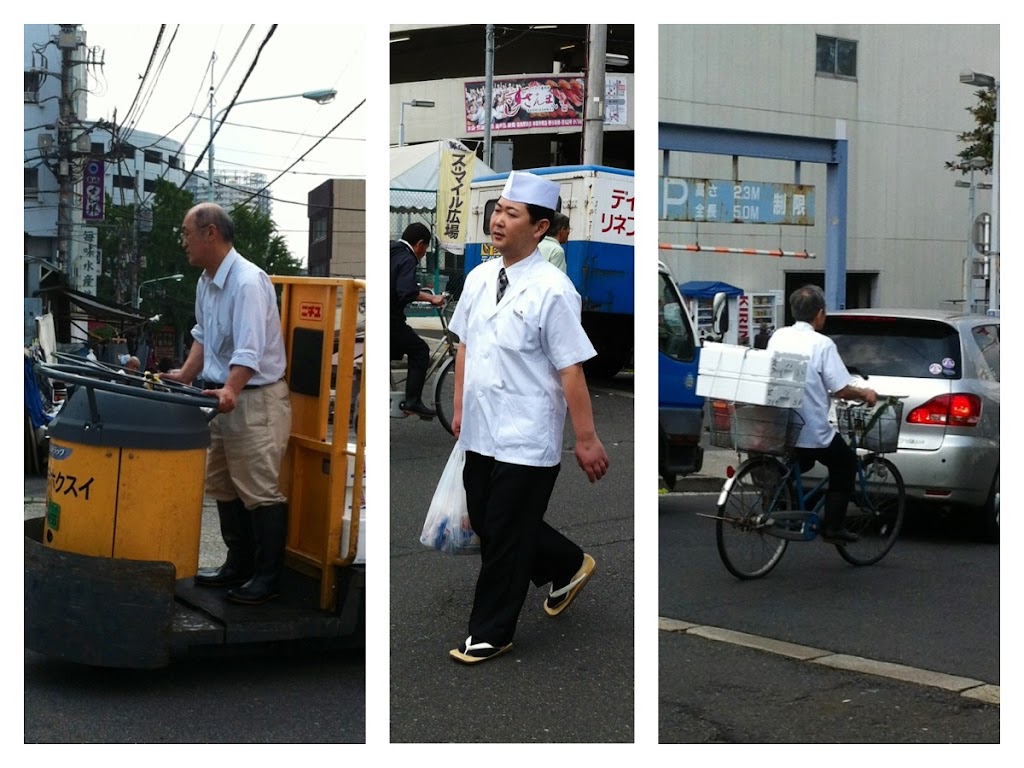
Mike and I have visited Tsukiji several times, but this may be the last because the Wholesale Market is scheduled to move about 3 miles across the waters to Toyosu into a more modern facility by 2014.  People conduct serious business at Tsukiji, and has never been designed to accommodate the volume of tourists that descend upon this market every morning.  Surely, the move to Toyosu will take tourists into the consideration of their design; yet, I already feel a loss for the rows of dank warehouses, navigating the endless confusing maze of wholesalers, motorized carts trying to run us over, grumpy fishermen staring us down, the disapproving look when we try to take pictures, and simply just trying (without much luck) to stay out-of-the-way.  After a guarded walk through the Inner Market, we can't help but feel like we conquered a life-size game of Frogger.   We then reward ourselves with a huge helping of the freshest fish we will ever get our hands on at any of the myriad sushi counters. 


A great explanation of what to expect and proper tourist etiquette is written through JapanGuide.com.

Note that the famous tuna auction is closed to the public.  Tourists who want to see the auction must apply for a visit starting at 5 am.  The first 120 applicants are given access.  Needless to say, we haven't been THAT motivated to witness this event, although it could be an excellent way to make use of the jet-lag!  


Thursday, May 31, 2012

Frijoles, the Tokyo Version of Chipotle

This is how it started.  Mike and I were walking down the street on one of our final days in Tokyo declaring that, "When I land in Atlanta for 2 days before we head to Ecuador, I seriously NEED to get my Chipotle fix".  And that was that.  We continued our walk in the Azabu-Juban area of Tokyo where we were immediately drawn to an Irish pub because they advertised FREE wifi.  Over  ¥900 ($12) Guinness drafts, we caught up on our emails, Facebook, etc. when suddenly, Mike Googles a potential Chipotle-esque restaurant in Tokyo.  At that moment, I 'may' have dived over the table and grabbed his iPhone from him, trying to find the address.  Lo and behold, this place is literally around the corner...maybe 50 feet from where we were sitting!!!

Frijoles was opened in 2009 in a style VERY reminiscent of Chipotle.  According to the blog From Tokyo to the World, "Frijoles is essentially the Japanese local version of America’s Chipotle chain. In fact, it is so very much like Chipotle, down to the decor and the menu, that I wouldn’t be surprised if the owner was breaking several international copyright laws. That is completely fine by me, however, because it’s just what Tokyo needed."  

Mexican food hasn't ever taken off in Japan.  That makes Frijoles extremely helpful for Americans craving a little taste of home.  All 3 locations are concentrated around the areas where expatriates live - Akasaka, Roppongi, and Azabu-Juban.  


The menu is all in English, the servers all speak English, they have unlimited refills on drinks (unheard of in Japan), and they provide napkins (whoa, another Japan first).  

Mike's carnitas tacos looked and tasted almost the same, but less filling for almost $14.  My chicken burrito bowl was about half the portion size (and twice the cost at $12).  The burritos looked about 2/3 the size of what Chipotle serves.  Although most of the ingredients were similar, the rice was not the cilantro rice, and the chicken had a different seasoning.  All the salsas looked the same, including the pico de gallo, corn salsa, tomatillo salsa, and so forth.  


Overall, Frijoles didn't satisfy my Chipotle craving exactly, but if I lived in Tokyo, I would definitely be a regular at this place.  

Map to the Frijoles, Azabu-Juban location.


Saturday, May 26, 2012

Sasebo Burger in Tokyo

Love Japanese food but sometimes, a taste of home is what the doctor ordered. Sasebo Burgers are a special kind of burger since 1950 when an American GI taught some Japanese how to make a real American burger. Typically, a hamburger conjures up an image of a hamburger steak with gravy, in Japan.

A Sasebo burger has the following characteristics. There are several burger joints around Tokyo that serve a burger in this style:
1. Fresh/handmade
2. Use only Japanese beef
3. Soft bun
4. Special mayonnaise with 9 spices
5. High quality egg for the fried egg
6. Cheddar cheese
7. 5 mm cut thick bacon from Kyushu, Japan
8. Lots of veggies (lettuce, tomato, onion)
9. Instructions for eating include pressing the burger down before eating to ensure all the sauce/juices are mixed together and throughout the burger

www.sasebo-burger.jp


Friday, May 25, 2012

Day 24: Tamura Sake Brewery

At 190 years old, Tamura Shuzojo (田村酒造所) (www.seishu-kasen.com) is the oldest sake brewery in the Tokyo area.  It is located approximately 1-hour by train (on Chuo JR line towards Ome), west of Tokyo in a suburb called Fussa.  The Yokota Air Force base is located nearby.  

My (Akiko) dad inquired about visiting the facility, and we were granted a private tour for the 7 of us.  They were very worried about the language barrier, as they do not speak any English, so we reassured them that between me and my dad, we should be able to translate for them.  As it turns out, translating is a tough job, especially when I am also unfamiliar with the process, but I think the group got the general idea!  During the 1-hour tour, we were shown the areas depicted in the diagram below, ending with a tasting, of course...


(The 26 mile aqueduct and Tamura's private intake pump that looks like a fire hydrant)
Since 1822, the Tamura family has been making sake in the Fussa village.  Currently, the 16th generation Tamura is the sake master.  The location of the brewery is largely in part due to the spring water source.  Water from the same well dug 190 years ago is still being used to make the sake.  In fact, their brand name is called Kasen, or 'spring of joy'.  A 26 mile aqueduct diverting water from the Tama River was constructed in 7 months during the Edo Period (1653 AD).  This aqueduct is now a historical site.  This was the main drinking water and water supply for daily living in this region.  33 intake watersheds off of the main aqueduct were created to divert the water through the neighborhoods.  Only 2 of them are privately owned, including the intake that goes to the Tamura property.  In the olden days, this watershed helped turn the watermill used to grind and polish the rice kernels for sake.  

(Old watershed through Tamura's property)

(Former water mill where rice kernels were polished down by the stones)

Albeit the difference in ingredients, the sake brewing process is more similar to beer than wine.  

RICE:  special brown rice for making sake called shuzo kotekimai is larger, stronger, and contains less protein and lipids than rice that is eaten.  The rice is first polished down to remove the outer bran layer to maximize the central, starchy component of the grain called shinpaku.  The amount of the outer layer polished off affects the quality of the sake.  The more polished = higher quality.  Typically, about 30% of the outer layer is removed for sake, but at Tamura Sake Brewery, they usually remove 55% of the bran, and up to 70% for the most premium brands.  

KOJI: The rice is washed, soaked, then steamed.  The steamed rice is then inoculated for 2 days with the mold spore, Aspergillus oryzae, or koji in Japanese.  Unlike beer where the malt naturally has enzymes to convert the starch to sugar (as food for the yeast), rice does not naturally have these enzymes.  The koji spores provide the needed enzymes to convert the rice starch into sugar.  

(original 190 year old brewery building with old wooden beams without nails. No damage from the most recent major earthquake in 2011.)

YEAST: While the koji is working, yeast is added to the koji/rice/water mixture, converting the sugar into alcohol.  This is done over 3 weeks in tanks at a cool temperature.  The premium sakes are deliberately fermented slowly at a very low temperature over a longer period of time (5 weeks).  

PRESSING:  The sake is filtered through a press by removing the solids.  

PASTEURIZATION:  The sake is then pasteurized at 65 degrees Celsius (149 degrees Fahrenheit) and bottled for longer storage.  Unpasteurized sake is called namazake, and should be consumed relatively quickly or else it will spoil.  All sake should be consumed within a year of bottling. It does not age well like wine.


We also took a tour of the grounds full of beautiful trees and plants.  2 very large cedar trees were planted 700-800 years ago, and still serves to keep the brewery building cool from the summer heat.   

At the end, we were able to sample several grades of sake, and of course, we all made purchases!  


If anyone is interested in making a trip to this sake brewery, my suggestion is to have a Japanese speaking person call, make a reservation, and bring along an interpreter.  

(the original well)

Thursday, May 24, 2012

Day 23: Yakatabune (Japanese house boat) Dinner Cruise in Tokyo Bay

After our day trip to Kamakura, we headed towards the north part of Tokyo Bay, where we boarded a Yakatabune (traditional Japanese house boat) dinner cruise down the Sumida River and Tokyo Bay.  Again, our friend, Kaori Takeuchi-San arranged for all this as none of us had done anything like this before.  


Apparently, it is a popular activity, written in CNNGo.com in an article titled "Yakatabune: Party Boats Ply the Bay" by Julian Ryall.  There are many companies operating a similar dinner cruise, serving different types of food.  All of them are all-you-can-eat-and-drink (beer/cocktails) for a set price for a 2 - 2.5 hour boat ride.  Many operations charge around ¥10,000 ($125/pp), depending on the type of food served.  Ours was a steal at ¥4900 ($60/pp) through a company called Edo-Mae Kisen, operating near the Shin-Kiba train station.  


Our boat served what is called monjayaki.  It is a communal food that usually includes cabbage, meat, and a loose batter; where everyone cooks and eats monja off of a hot plate; and is a native dish to Tokyo.  Here was our menu (provided in English).  They even gave us cooking instructions in English.


Our first monja course was a little strange for some of us.  It included fish roe and mochi (glutinous rice).  The second monja was a little more palatable with cheese and eggplant as the main items in the batter.  We also ordered a similar dish called okonomiyaki, which is very similar to monjayaki but it is cooked until the batter is firmer.  It is sometimes referred to as a savory Japanese pancake.   We also had yakisoba, or fried noodles.


Everyone's favorite was the shrimp doria, which is a rice dish that tasted like a very creamy, cheesy, risotto!  We ended the night with the chocolate banana dessert cooked on the hot plate, starting with butter, then chopped up bananas, coconut, chocolate, and cornflakes!  

We were pretty busy cooking our own food, but was also able to enjoy the Tokyo skyline at night and the Rainbow Bridge.  Although it was difficult for us westerners to sit on the floor with our legs crossed for over 2 hours, the time flew by really fast, and we recommend this experience to anyone visiting Tokyo.