Showing posts with label Lessons Learned. Show all posts

Wednesday, December 12, 2012

Things We've Never Said in Tokyo Before (Our Travel Sabbatical)

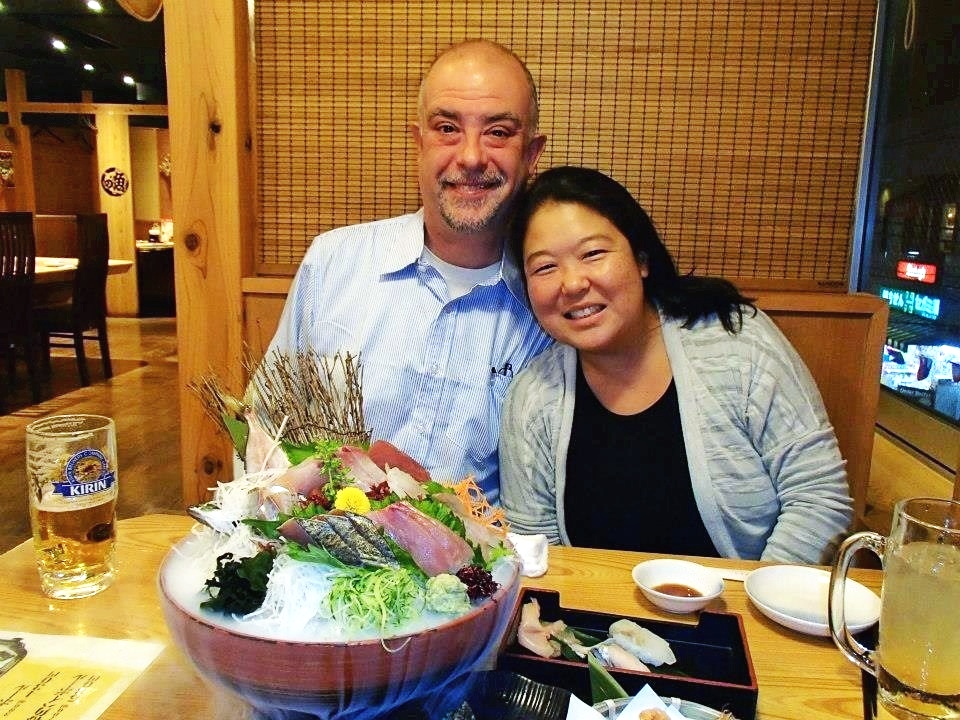
As we prepare our transition back to "real life" after 7 months, we are unwinding in Tokyo and catching up with Akiko's dad.  Tokyo is Akiko's second home and Mike's 6th time visiting, so this place is not a new experience for us.  We thought we had Tokyo figured out, but how funny that everything is relative and subject to perspective, especially after experiencing all the places we've been on our Travel Sabbatical.  

Here's a few things we've never uttered before on our trips to Tokyo...'til now:
  • "Wow, it's so calm and orderly here."
  • "Why are we waiting for the light to turn?  I think we should just cross the street now."
  • When approaching any shop, vendor: "Irasshaimase (Welcome!) is so much better than 'You buy sometheeeeeeng!'"
  • Observing cars driving down narrow streets: "Pretty sure they could squeeze in one more lane and at least 2 buses, and 50 motorbikes into that street."
  • On riding the bus from the airport: "Really? It goes directly and non-stop to Kichijoji?  That's amazing."
  • "I bet I could negotiate that train ticket down from ¥160 down to ¥40."
  • "What do you mean it's a fixed price?!"
  • "Hmmmmm.  $10 beer versus 50 cent beer.  Missing the sidewalk beer in Saigon."
  • "The streets are so clean, organized, and the shops so pretty, I feel like I'm on a movie set."
  • If Southeast Asia adopted Japan's trash separating system: "These boxes get thrown in that street; these plastic bags get thrown on another street; and styrofoam can only be thrown out the window on Mondays and Thursdays."
  • "Dear tap water: I will never take you for granted again."
  • "Are you sure they're open during their siesta time (usually noon until 1 or 2)?
  • "I feel like a paranoid freak, holding onto my travel pouch like someone cares.  I forget no one wants my shit.  Everyone has a better iPhone, a Japanese passport, and way more money in their wallet than I do."
  • "They could soooo accommodate more customers at this restaurant if they exchanged their nice furniture for short red plastic tables and stools."
  • "Why not."
  • "Can't believe those dogs are on a leash."
  • "Seriously?  You actually have plenty of change for my large bills?  Weird..."
  • "When the train conductor says its a one-minute wait, it's probably a true 60-second wait, instead of a one-minute-means-at-least-ten-minute-wait."
  • "Toilet paper.  Oh, how I love thee."
There's probably more, but here it is.  Welcome back to civilization.  

Wednesday, September 19, 2012

A Headache to Deal With Bank Card Fraud While Traveling

We reported back in June that there may have been unauthorized use of one of our bank debit cards we use to withdraw money only (we never use it as a credit card).  After discussing with the claims department, the charges were reversed and the incident never occurred again so we thought it might have been just an honest mistake of wrong account number or something.  (During the same time, we did have a confirmed fraudulent charge on one of our credit cards, which we immediately canceled.  Fortunately, it wasn't one of the cards we are traveling with).  

Fast forward to September.  We recently discovered 2 new unauthorized charges on the same bank debit card and this time, we immediately got it stopped.  Bad news (besides the fraud)? We're now down an ATM card.  Good news?  We carry debit cards for 2 separate accounts so we still have the ability to withdraw money.  Except, when one doesn't work, we don't have a backup debit card.  We've come across this several times on our journey already where one works but the other doesn't...so, we were worried about getting the replacement card quickly.  

What a State Department's Security Warning Looks Like

We aren't traveling in a bubble.  We keep up on the news, and have been just as concerned as everyone else about the recent attacks on United States embassies and angry extremists capable of harming a lot of innocent people.

We are trying to be as safe as we can, being aware of our environment and such; but we have no intention of changing our itinerary unless there is something more compelling, such as news that the State Department is evacuating staff from a country, for example.   

Having said that, one thing we did do was to register our travels through the State Department's Smart Traveler Enrollment Program (STEP).  By enrolling, we receive latest security updates and makes it easier for the nearest US embassy or consulate to contact us in an emergency. We're also provided the embassy/consulate address and contact information, including an emergency contact.

Monday, September 10, 2012

Quirks and Difficulties of Traveling Through the Balkans


From Sarajevo, we literally didn't have an exit plan because we couldn't make a decision on which direction to head.  We thought about going south towards Mostar, Bosnia and Hercegovina (BiH), then Montenegro, then Albania, but we found out that Albania does not allow public transportation to cross its borders from some of the other Balkan states.  It didn't sound like something we wanted to hassle with.

We considered taking a more off-the-beaten-path route, but again, cross-country transportation outside of major cities is sparse and lodging unreliable.  

We really wanted to raft down the super-deep Tara Canyon river in Montenegro, then go east through Kosovo, then Serbia, but getting to and out of Tara Canyon sounded like it would take many extra days.  Also, we're very glad we didn't do this route because Serbia would not have allowed entry had we gone through Kosovo first.  It has to do with territorial disputes about Serbia's claim over Kosovo, and it's complicated, but Serbia considers going through Kosovo first, an illegal border crossing.

Basically, we've considered several different itineraries each time, but most are eliminated due to transportation or border crossing issues.  The places we've been during the past 2 weeks represent the path of least resistance.

Wednesday, August 8, 2012

Warning About Trying to Exchange Argentine Pesos to US Dollars

Read carefully if you, or someone you know is planning on traveling to Argentina in the near future, because we just lost an equivalent of ~USD$200 dollars.  How?  

When we were leaving Buenos Aires, we still had about AR$1200 pesos leftover; however, due to recent Argentine monetary policies (more on that in a moment), no legitimate currency exchange house will trade AR$ pesos into US dollars or Euros or any other currency for that matter.  Basically, we are sitting on a pile of cash that is only good in Argentina.  Unless we go back to Argentina, we might as well use it as toilet tissue because it's just paper to the rest of the world.

Monday, August 6, 2012

How-To (Or How-Not-To) Refill Prescription Meds While Traveling

We had a solid Plan A.  Before we left on our trip, we had our 90-day supply of prescription meds, plus we even received from our discount prescription provider, Medco, an additional 90-day supply through their "travel" program.  Usually, they would not release more than a 90-day supply; however, they will for travel purposes.  Instead of carrying around a 6-month supply of meds (very bulky and takes up precious backpack space!), we decided to have someone mail the next 90-day supply to us while we were in Argentina for 3-weeks.  Genius, right?  Well, not so genius when...

Tuesday, July 31, 2012

Day 88: Random Buenos Aires Adventures

This is a random assortment of events in one blog with buses, Kansas Grill, Thai Embassy, etc., but it all happened in one day, and it was quite adventurous so read on!

We thank our lucky stars that we can do this kind of traveling without hassle by virtue of having been born in countries that allow their citizens to roam freely around most of the world (We don't take it for granted.  Our freedoms CAN be taken away).  There are others that require their people apply for visas to leave their own country, and plenty of nations that require visitors from certain places to apply for tourist visas before entry.  That's a lot of embassy hopping.  For the most part, our journey doesn't require us to obtain special visas.  Except, if we want to stay in Thailand for longer than 30 days in October, which we do.  

It seems premature to apply for a tourist visa in July (for October), but looking at our next 2-3 months, we will frequently be on-the-go without the benefit of a Thai Embassy nearby.  Since we're hunkered down in Buenos Aires (BA) for 3-weeks, why not get this business taken care of now?  We did have to consult our calendar because we cannot be too hasty...we must enter Thailand within 90-days of issue, or else the visa expires.  This happens to be the perfect window of opportunity.  

Monday, July 9, 2012

Day 67: Mixed Feelings About the Town of Machu Picchu Pueblo, Peru

Despite the beautiful setting, we don't have all positive things to say about this town that has, for the most part, been developed to meet the tourist influx to the famous site.

Machu Picchu Pueblo, formerly called Aguas Calientes, is a very small town that sits in a narrow valley flanked by the tree-covered granite faces of the imposing mountains rising above.  Río Aguas Calientes runs through the valley in which the town surrounds.  The main access is by train or by foot along the Inca Trail.  We have no idea how the buses and cars arrived here because there seems to be no roads leading in and out of the town.  Therefore, it is quite isolated and similar to living on a small island.  Because the town was built over the shores of the rocky river banks, there is no grass and not a lot of trees in town.  They built one fútbol field with faux grass for recreation, and the kids just play on the concrete streets and stairs.  There are lots of stairs!  Although the town is surrounded by nature, the nature seems difficult to access since the mountains are so severe and the river is too swift and strong to get in.  
Our lukewarm feelings about Machu Picchu Pueblo may be due to our not-so-great hostel stay, or getting price-gouged for mediocre to bad food at almost every restaurant we ate at.  This town is clearly in the business of tourism, but also in the business of taking advantage of tourists, which is not a very welcoming feeling.  They do have the upper hand, however, because most tourists have to go through this place to get to Machu Picchu.  

Our initial immersion into Machu Picchu Pueblo was at a restaurant where we ordered our a la carte meals and got charged for the more expensive platter versions (that was almost double the price).  Then, they added 20% service fee on top of an already outrageous price, so this meal ended up being one of our most expensive meals we've had in South America and the worst tasting.  It was just easier to pay than to try and argue in Spanish that this isn't what we ordered, etc.  
We also found our hostel, Margarita's House, to be rather mediocre for the price and felt there was almost a bait-and-switch because the experience was so unlike the reviews we read online.  We knew that there would be situations that didn't meet our expectations, but since we have had great hostel experiences thus far, perhaps this made it more difficult to accept our disappointment.  Regardless, the whole experience was just strange.  Read our rants about it here.  

For such a touristy place, we only found 3 ATM machines: one required their bank card to access the locked door; one was broken; and one that actually worked. And, why do ATM machines only spit out large bills that no business can provide change for? Not helpful. 

However, any tourist staying at one of the nicer hotels like Inkaterra Lodge for $800/night would have found this town very charming, quaint, and beautiful to look at.

The silver lining to Margarita's House was its close proximity to Inkaterra Lodge, where we ended up spending quite a bit of time in their lounge, enjoying the ambience, service, and free wifi.  We also ended up eating a few meals at the Lodge restaurant because unexpectedly, the price was comparable to the tourist restaurants in town, but far better quality.  
We also unexpectedly stumbled upon the biggest outdoor party at Plaza de Manco Capac on Saturday night.  It was the 50th anniversary party of something major in Machu Picchu.  There was live music, food vendors, beers, Pisco sours, and people dancing everywhere.  Families with small children were still partying when we went to bed at midnight.
We are not traveling in a bubble, so these mixed feelings will occur again. Overall, the experience - good or disappointing - is all part of our collective memory and we are glad to have had the opportunity to visit this town.

Thursday, July 5, 2012

Week 9: Cuzco, the Imperial City of the Inca Empire

Cuzco (or sometimes spelled Cusco), meaning "navel of the world", is a famous city over 11,000 feet high in the Peruvian Andes.  It is famous for several reasons:

1.  Gateway to Machu Picchu, the world's number one archeological site and Peru's number one tourist destination
2.  Home to Sacsayhuaman, greatest Incan ruin outside of Machu Picchu, believed to be a royal retreat or fortress.  
3.  Capital of the Incan Empire in the 15th century
4.  Oldest continuously inhabited city in the Americas 

Okay, but why in THIS remote part of the Andes?  Legend says that in the 12th century, the first Inca, Manco Capac, was charged by the sun god to find the navel of the earth - a spot where he could plunge a golden rod into the ground until it disappeared.  This spot was Cuzco, and therefore, it became the Incan Empire's (Tawantinsuyu, "four parts together") capital or imperial city.  The huge Empire was divided into 4 parts:  Chinchaysuyo, Antisuyo, Cuntisuyo, and Collasuyo regions, and Cuzco was the central point from where each region extended out.  

Cuzco is built in the shape of a puma - a sacred animal to the Incans.  The head of the puma is represented by the fortress, Sacsayhuaman, the heart of the puma is the main Plaza Huacaypata (now called Plaza de Armas), and the converging rivers - Huatanay and Tullumayo - represents the tail. 
When the Spaniards conquered the Incans in the 1533, they built a colonial city atop the foundations of the Incan empire because it was so well-built and earthquake-proof.  Cuzco colonial buildings are very well-preserved and ubiquitous.  There isn't "a section or place" in Cuzco to go check it out.  The entire colonial city seems like we are on a movie set.  It is one of the most charming places we've ever experienced.  

Therefore, it is one of the most touristed places.  For a tourist, it is a comfortable place because the city truly accommodates to the travelers' needs with great accommodations, food, English speaking personnel, etc.  However, because it is such a touristed place, we are constantly harassed by street vendors, not to mention the aggressive cab drivers and sales people at the airport that prey on the naïve tourists.  

After experiencing 5-weeks in South America, we are getting better at driving a hard bargain with these vendors offering transportation and lodging.  Guidebooks and the hostels will publish the standard taxi rate, so we know if we are getting screwed.  At the Cuzco airport, literally, 10-15 cab drivers surrounded us, trying to take us to our hostel.  All of them started at 30 Soles, which we balked at.  They quickly took it down to 20 Soles - still too high.  So, we started walking away, but they surround you without any regard for personal space, so it can be overwhelming.  We were throwing out "Quince" (15 Soles), and finally a cab driver took us up on our offer and all was well.  We know it's only a $5 difference between 30 Soles and 15 Soles, but every penny counts and it's the principal of it - we're not the naïve gringos they can take advantage of.  Speaking a little Spanish when negotiating also helps.

Anyway, here are some photos from our short week in Cuzco.  Enjoy!

Our first stop was Paddy's, claiming to be the highest Irish bar on earth at 11156 feet! Besides beers, the menu looked really good so we split a Shepherd's Pie - flavors we haven't been able to access in almost 2 months. The views of Plaza de Armas was an added bonus.
Plaza de Armas (or used to be called Plaza Huacaypata) has been the center of town since Inca times. It is flanked by the main cathedral and La Compañia de Jesus church.

Even after a short walk, the camera was 'blowing up' with photos of sooooo many beautiful buildings, alleys, walkways, streets! Here's just a few.

In the following photo, on the right is Inca stone foundation wall famously called the 12-sided stone where the stones fit so perfectly that there is no space for even a piece of paper; juxtaposed by the "regular" Spanish built wall on the left.

Around San Pedro is a huge outdoor and covered market.

[Vendors selling dry goods such as beans and baskets.]
[A whole aisle selling menudos (innards)]
[Fruit stands alongside traditional Andean clothing.]
[The "la ropa" clothing aisle!]
[Rows and rows of food stalls serving lunch at San Pedro Market.]

Incans worshipped the god of sun, or Inti. Q'orikancha or "Golden Temple" is the most important temple in Inca Empire, dedicated to Inti and can be located off of Avenida El Sol. There is also a nice Incan mural and a monument of Inti.

One place that we want to see before we leave Cuzco is the Incan fortress of Sacsayhuaman.  It's a short 30-45 minute walk from the center of town, but it's up a steep hill.  We've been trying to get over our altitude sickness so we haven't had the energy to make this trek on our first couple of days in Cuzco.  The altitude sickness feels like having the flu.  Mild headache, loss of appetite, insomnia, cold, and definitely shortness of breath on just a little bit of exertion.  We will be back in Cuzco after our trip to Machu Picchu, so hopefully, we will have something to report on Sacsayhuaman next week!

View all Peru Photo Album.


Saturday, February 11, 2012

Lessons Learned from My Greencard Renewal Saga

Greencard, I-90 Visa, Permanent Resident Visa, etc. However you want to refer to it is fine, but they all mean the same thing. I (Akiko) am a Japanese national, living in the States with a permanent visa since 1990. At this point in my life, I can't imagine living and working in Japan; so I am VERY grateful for this opportunity that has been given to me and my brother through efforts that took over a decade with the help of many people, including our uncle Yoshi. (And no, despite the movies and popular belief, one does not automatically receive permanent residency or citizenship by marrying an American).

One recent unexpected stressor in our travel plans has been the renewal of my Greencard. The visa needs to be renewed every 10 years. So, a permanent visa is not so permanent after all! But, no big deal. I've been a model resident - I've renewed it before, no problem. I knew my visa expired in March 2012, and with all the upcoming travels, it was definitely a priority item.