Tuesday, May 22, 2012

Day 22: Asakusa and Shinjuku

A 'must-see' for any tourist to Tokyo is a visit to Asakusa, the old-town area where the famous Senso-ji buddhist temple from the 7th century stands, guarded by the large Kaminari-mon (gate)with a very, very large lantern hanging from the center. A 'few' centuries later, Asakusa became the entertainment district during the Edo period, but never regained its significance after the area was destroyed during World War II. What remains is the temple area full of shops selling traditional Japanese items, food, and souvenirs. We were greeted by a steady rainfall, making any outdoor sightseeing a challenge, but we prevailed!

Mike and Akiko in front of the Kaminari-mon (gate).

Shopping in Asakusa! Nakamise-dori.

Streets of Asakusa. Amy getting a fortune at the temple.

Meditating Monk, Asakusa.

To get out of the rain, we headed to Shinjuku (新宿)- a MAJOR commercial and administrative center of Tokyo with the busiest train station in the world. There's enough underground walkways, retail, and restaurants to keep us out of the rain and busy for the next 100 years!

Our first stop? Conveyor belt sushi! Conveyor belt sushi is a popular lunch destination because it's usually relatively inexpensive and fast. It's good for foreigners as well because you can see all of the options moving past you, only selecting what you want. This particular restaurant in Shinjuku called Numazukou, ranked high on lunch conveyor belt sushi places in Tokyo. They did not disappoint!

Numazukou (conveyor-belt) sushi restaurant, Shinjuku. [from left] Mike, Kris, Rachel, Amy, Lisa, Noriko.

Numazukou (conveyor-belt) sushi restaurant, Shinjuku. [from left] Chef preparing a live halibut, flapping around. Various nigiri and rolls.

After a full stomach, it was time for...retail therapy! Akiko's favorite store in Shinjuku is Tokyu Hands, an 8-level store packed full of amazing Japanese ingenuity, gadgetry, design, and products. We never left the Shinjuku train station surroundings, but that was enough to keep us window shopping for HOURS. Every space, nook and cranny is dedicated to retail.

We finally sat down for some cocktails at Mike's favorite little Spanish tapas bar in Shinjuku. It's a great spot for people-watching and commenting on Tokyo fashion. We've sat here many times in the past, always trying to predict the future fashion in the States, based on what we see walking by, and we've usually been correct! So, looks like the 80s theme continues...stirrups and scrunchies are making a come back. Above the knee socks with ultra-minis....

Another favorite Shinjuku spot is the New York Bar on the 54th floor of the Park Hyatt - hotel made famous by Sofia Coppola's movie, Lost In Translation, with Bill Murray and Scarlett Johansson. We like to order some (budget-breaking) cocktails and watch the sunset. For non-hotel guests, there is a steep cover charge after 8pm.

View from the 54th floor of the Park Hyatt. Late afternoon versus after sunset.

Well, that's it for today! Headed to Kamakura to see the big Buddha tomorrow.


Saturday, May 19, 2012

When You Have a Cold in Japan

Visiting a Japanese drugstore is an 'adventure', even for someone like me who is a nurse and can figure things out in Japanese. My prior experience with visiting a drugstore in Japan is rare because my mother was a pharmacist and she had access to all the awesome remedies! Since she passed away, though, we're sort of on our own. Best just to describe your symptoms to the pharmacists behind the counter and ask for a recommendation. Most of them can understand some English.

Here's some helpful information from the blog, Surviving in Japan Without Much Japanese: 7 words to know when you have a cold (in Japan).

After describing our symptoms of a cough/phlegm, we were given this medicine from behind the counter. Fortunately, many of the active ingredients (except for the eastern medicine components) are listed in their generic names, which are universal (except for acetaminophen versus paracetamol, etc.), as written previously in the post, Foreign Equivalents of Over-the-Counter Meds.


Friday, May 18, 2012

Day 18: Sumo Wrestling Explained


Embarrassingly, all I knew about sumo wrestling is that it is this national sport of Japan, my parents watch it on TV, and I remember my dad listening to it on the radio when he drives...which doesn't exactly sustain your interest if you don't know what's going on.  Just imagine listening to NASCAR on the radio.  It's not the same as being there, that's for sure.  So, to better understand and appreciate this ancient sport of sumo, we weren't going to miss this opportunity to go see it for ourselves.  There's only six 15-day tournaments per year, and 3 of them are held outside of Tokyo so it's sheer luck that the Grand Sumo Tournament was going on during our visit.  

Much of the following information can be found through the literature handed out at the tournament, and also through the Japan Sumo Association website: The Beginner's Guide to Sumo.

According to Japanese legend, the very origin of the Japanese race depended on the outcome of a sumo match between the gods.   Apart from the legend, sumo is an ancient sport dating back at least 1500 years where it was a religious ritual dedicated to the gods with prayers for a bountiful harvest.  In the 8th century, sumo wrestling festivals became part of the Imperial Court in Nara, but when a military dictatorship was established in Kamakura, sumo was used militarily.  After peace was restored under the Tokugawa Shogunate in 1603, sumo groups were organized as entertainment and became the national sport of Japan.

The sumo wrestlers belong to a sumo stable, or sumo-beya, where they train and live under the oyakata or stable master (coach).  Currently there are approximately 49 stables.  The wrestler is expected to remain in the same heya until the end of their career.  According to my dad, there are quite a few heyas in the Suginami Ward of Tokyo where we live.

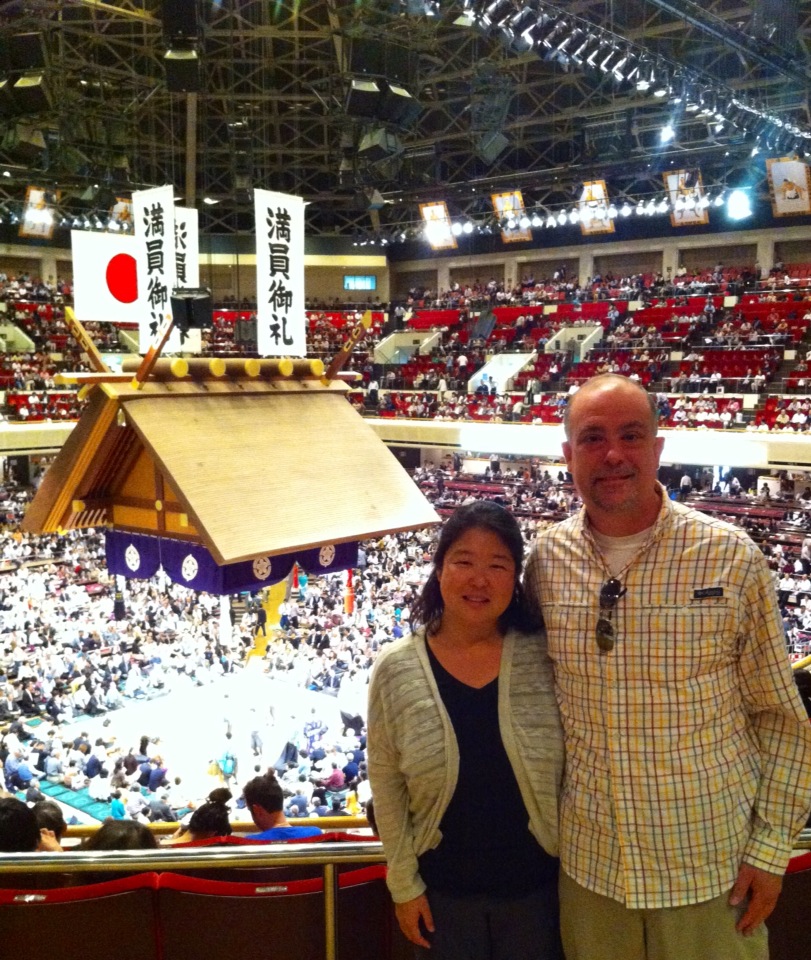
At the Kokugikan, Tokyo. Lower ranked sumo wrestlers stand around the arena.

View of arena, Kokugikan.

The sumo 'stage' is an elevated square made from a special kind of clay and the 15-foot diameter sumo ring, or dohyo, is marked by straw rice bags.  The hard clay surface is covered by a thin later of sand.  A Shinto shrine roof is suspended over the top of the dohyo by cables.

There is a lot of ceremony surrounding a sumo event, but the rules are quite simple.  The wrestler, or rikishi, who touches the ground with any part of his body (e.g. knee, tip of his finger, hair), or puts his toes or heel over the straw circle, loses.  There are no weight classes or limits.  Matches are arranged solely based on prior record and ability so it is possible for a smaller, short guy to be matched with a much larger, tall wrestler.  

According to the Japan Sumo Association (Nikon Sumo Kyokai), there are 800 rikishis of various ranks.  After each tournament, the rankings are revised based upon their performance over the past 15-days.  There are six group rankings.  Maku-uchi group being the  upper division, containing the top 42 rishikis (wrestlers).  The remainder are ranked in the other 5 groups: juryo, makushita, san-dan-me, jo-ni-dan, and jo-no-kuchi.  We noticed quite a few foreign wrestlers from eastern Europe in this upper division.  

One of the maku-uchi division matches.

The top 5 positions within the maku-uchi division are: Yokozuna, Ozeki, Sekiware, Komusubi, and Maegashira.  The Yokozuna top-dog position is earned by winning 2 consecutive tournaments in the Ozeki position, but also proving oneself capable of consistent wins, as well as a person of character worthy of the position, as determined by the Association.  This position is unique in that once a rikishi receives this title, he can never be demoted, even if he cannot defend his record.  Instead, if he continues with a losing streak, he is expected to retire. There have only been 69 Yokozunas in the past 300 years, so they hold on to their title for quite some time.

Photo with a life-size cut out of the current Yokozuna, Hakuho. Also, notice the massive ceremonial braided hemp rope weighing 25 to 35 pounds.

The rikishi's loincloth is called a mawashi. It is made of heavy silk 10 yards long by 2 feet wide.  There are multiple maneuvers and winning strategies by the way a rikishi grips the opponent's mawashi.  One of my dad's favorite sumo wrestler is small-framed but has won many matches with his superior strategy of throwing opponents out of the ring using the mawashi.  During the ceremonies, the rikishis wear kesho-mawashi, or ceremonial aprons made of silk and embroidered with various designs - usually logos of sponsoring organizations.  One wrestler had a kesho-mawashi with Hello Kitty on it! The aprons cost around $5000 each. 

A Hello Kitty kesho-mawashi.

During the 15-day tournament that occurs 6 times a year, each of the rishiki in the top 3 divisions (maku-uchi, juryo, makushita) wrestle once each day. These are the salaried, professional wrestlers.  Matches are determined by their previous day's record, saving the best for last.  

Advertisement of the sponsors that donate prize money for some of the more important bouts. Winner of that particular match wins the prize money.

For each of the division matches, it begins with a ceremonial entrance where the rikishis stand on stage in a circle, facing the crowd in their ceremonial aprons.  Then, for the maku-uchi division matches, the Yokozuna enters the ring to perform a cleansing ritual.  After all the matches are completed for the day, a bow dance ceremony closes the day's events.  

Ceremonial entrance of the maku-uchi division rikishi.


Overall, this was an amazing experience! We recommend attending an event. We saw quite a few foreigners in the audience as well. Our seats in the upper tier were approximately $100/seat. The lower tiers, closer to the dohyo are not seats but sections of tatami mats and the audience sits on traditional zabuton cushions, which can get rather uncomfortable for most westerners not used to sitting on the floor for an extended time. Tickets can be purchased in English at http://sumo-tickets.jp/


Thursday, May 17, 2012

It's Good to be Home - Ogikubo, Tokyo

It's good to be home. I've lived in Ogikubo, on and off (mostly off, rather than on) since I was 8 years old. My dog, Ogi Kubo, is named after this area on the western edge of Tokyo. And, although my last name is Kubo, my family has nothing to do with the name of this area, Ogikubo! Just a coincidence, I guess.

For entirely opposite reasons than why I love Alabama (post on the most relaxing place on earth), I also love Ogikubo because everything is accessible within 5 minutes of the house - major train station, huge retail center, small quaint side streets with restaurants, bars, entertainment - basically, everything that you will ever need and want...to the point where my dad rarely ventures out past the train station to go anywhere else. If we wanted to go elsewhere in Tokyo, it only takes about 20 minutes to get to Shinjuku - the city center - by train.

Ogikubo residential neighborhood where house is.

Why should anyone visit Ogikubo? Well, good question. It's really not a tourist destination. Just a great place to live. However, Ogikubo is known for its place in ramen history, as this is the birthplace of Tokyo style ramen. (Don't think instant ramen. The art of making ramen noodles and broth in Japan is equivalent to the art of barbecue in the States. Every region has its distinct style and broth, and no two are alike. There are ramen fanatics and books written about ramen, but more on that later.) A visit to Haruki-ya Ramen would be a worthwhile trek. Ogikubo also has an Anime Museum, for you Japanese comic/animation enthusiasts. Other than that, it's my Japan hometown, and that's why I love it.

Our futon beds in tatami mat in downstairs bedroom.

Supper at home: last night we made Japanese curry with rice, green salad, and bought fresh maguro (tuna) sashimi at the fish market.

My dad welcomed us with a nice green tea ceremony at home. Using matcha (powdered green tea), the tea and hot water is beaten to a froth with a bamboo frother in special matcha stoneware. Japanese sweets (youkan = red bean paste dessert) complement the tea nicely.

Beautifully displayed fruit at the supermarket...

More grocery store finds:
At Seven-Eleven convenience stores
Various seafood
More groceries...
...and more seafood, wagyu beef, fruits and veggies